
Communications on climate: a role for music?
21 November 2013
(This is the last in a series of three blogs from the D&C Days side-event at COP 19, Warsaw. The others follow on the Climate Centre home page.)
As negotiators prepared for the second week of climate talks in Warsaw – typically a difficult and slow-moving process – Liz Carlile, who is Communications Director of the International Institute for Environment and Development, enjoined participants not to leave the job of saving the planet to the climate negotiators: “They are negotiators not decision-makers. The decision-makers need all of us behind them, and that’s about communications.”
The Development and Climate Days (“D&C Days”) side-event saw participants singing songs, improvising collective rhythms, and playing games with dice and cards – unconventional activities conceived as a way jump-start creative thinking on climate communications.
The event drew more than 60 participants from relief and disaster risk reduction agencies, and climate and development organizations, working from the global to the community level, from countries as diverse as Uganda, Kenya, Nepal the Philippines, Germany and Poland.
Music dominated discussions in several ways. First, participants shared experience on grassroots communications strategies that have changed communities’ behaviours and led to new decisions on climate compatible development and disaster risk reduction: many of these positive experiences involved music and the performing arts.
‘A face they know’
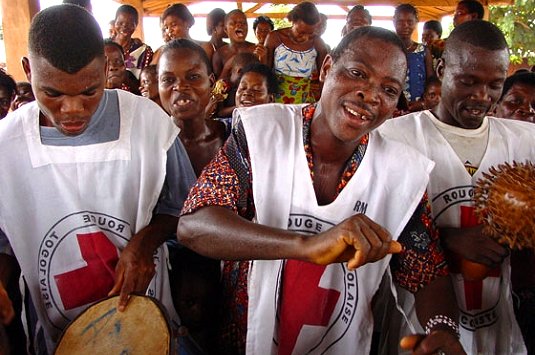
Shaban Mawanda, a programme coordinator for the Uganda Red Cross Society, said: “Our communities in Uganda and Kenya like music, dance and drama. If you want the village to hear, you just play the drums and they will come. So music, dance and drama are very powerful.”
Inviting community members to get actively involved, rather than sitting back and being lectured to, seems to be the key to success. “Whatever they do, let it be designed by the communities themselves,” said Mr Mawanda.
“If it’s mass media such as radio, if it’s a poster in the village, let it have a face that they know.
“We have also tried to promote the use of participatory video, where communities are involved in gathering documentation of their activities and then they come together and view it on the screen.”
Donna Lagdameo of the Climate Centre, a Filipina, found song not only grabbed community members’ attention, but also had the advantage of making her messages infectious. “I cannot stress enough the importance of repetition in climate messaging,” she said, demonstrating how she has used popular nursery rhymes – set to music – to communicate climate impacts and solutions.
The second role for music in the discussions was around the possibility of musical improvisation to stimulate creative thinking in disaster situations.
Comfort zones
This was a gear-shift from the earlier debate – it’s not literally about using music and drama to communicate with people in crisis. It’s about figuring out whether the unique skills that improvisational musicians and actors use to deal with unexpected and uncomfortable situations can be transferred to the field of climate risk management.
Pablo Suarez, Associate Director for Research and Innovation at the Climate Centre, suggested that this unconventional proposition might shake people out of their comfort zones and lead to new innovations.
As an inspiration, Dr Suarez screened American musician Bobby McFerrin’s Demonstration of the Power of the Pentatonic Scale Using Audience Participation and his improvisional performance with Joey Blake.
Watch the films and you will see McFerrin and his collaborators tune into each other’s body language and constantly anticipate and respond to each other’s actions, in the search for harmony.
To test workshop participants’ ability to improvise, Dr Suarez distributed simple plastic shakers and gave them five minutes, in small groups, to create musical performances.
Cross-fertilization
One set of participants did not share a common first language and struggled to communicate verbally, but were nonetheless able to produce a simple, harmonious performance; another group, who were already friends and could communicate easily in English, created an even more sophisticated performance in their allotted five minutes.
Carina Bachofen, a technical adviser with the Climate Centre, said that commercial businesses are beginning to be interested in the power of improvisation to unleash the creative potential of their employees; for instance, in designing new products and services and management solutions.
This particular cross-fertilization from the arts has barely reached the environment, development and humanitarian sectors. The Climate Centre will test the potential further in the coming months.
The theme of two-way communications continued throughout D&C Days. Participants from Taiwan and Japan stressed the transformative power of social media to mobilise the public around disaster preparedness and disaster response.
Naoki Mori of the Japan International Cooperation Agency (a supporter of the D&C Days COP side-event) reflected on how the Japanese public’s response to the devastating earthquake and tsunami of 2011, although not climate-related, could offer important lessons for all types of emergency preparedness. “Social media can play an important role in searches, rescues and fund-raising,” he said.
Music, dance and street theatre are all well-established communications techniques in the Red Cross Red Crescent, like here in Momo village, Togo, where local volunteers sang for residents to enthuse them about a major new integrated health campaign. (Library photo: IFRC)