Early warning early action
When disasters strike, Red Cross Red Crescent volunteers are often among the first to provide relief to victims. But in most cases, we can save more lives and reduce more suffering if we can act before a disaster. We have known for decades now that it is much more effective to evacuate people before a flood than to rescue people during the flood, or to provide relief to its victims. It is also much more effective to support farmers to find alternative livelihood options than to provide food aid when the harvest has failed. The Red Cross and Red Crescent are investing more into people-centred early warning systems so that their early action (preparedness and mitigation/prevention) are suited to face the rising risks of extreme weather events as a result of climate change.
- The handbook 'Early Warning, Early Action' is developed by the IFRC and is the Red Cross Red Crescent answer to rising climate risks. Go here
(pdf, 286 kB) for the Spanish version. - 'Early warning, Early action' is the overarching theme of the IFRC's planning process. Read more in their World Disasters Report 2009 - focus on early warning, early action

- Watch the 'Early warning, Early action' video
on the YouTube channel of the IFRC. - Download here a Powerpoint presentation on Early Warning, Early Action.
- Early Warning -> Early Action: A Regional Guideline for Effective Engagement in Early Warning Systems, produced by the South East Asia Regional Office.
- The CEWS: guiding Principles and The PAPE: key Messages are now available also in the public Web Site. Please find below the links:
www.ifrc.org
: http://www.ifrc.org/en/publications-and-reports/general-publications/
CEWS:GP http://www.ifrc.org/PageFiles/103323/1227800-IFRC-CEWS-Guiding-Principles-EN.pdf
and
PAPE key Messages http://www.ifrc.org/PageFiles/103320/Key-messages-for-Public-awareness-guide-EN.pdf
Low rainfall and/or drought checklist for National Societies
Drought is a slow onset disaster and can be caused by lack of rainfall. Its effect on a country can be magnified by lack of planning and management of the water resources/storage system. Small low-lying atoll island communities in the Pacific like Kiribati, Tuvalu, Cooks, Tonga, FSM, Palau, Solomon Islands etc depend on rainfall and desalination as their main water sources. Not all countries will declare drought when low rainfall occurs, that doesn’t mean preparedness and response actions can’t be taken, it just means that we need to be watching forecasts, water levels and health indicators to act appropriately.
It is important for National Societies to be clear on which areas to focus on when responding to drought, and preparing for low rainfall whether it is provision of potable water, basic sanitation and/or hygiene promotion.
Using Climate Forecasts for Early Action to Save Lives in the West/Central Africa Zone
- With the onset of climate change, the Federation and National Societies must be ready for the increasing occurrence of extreme weather events such as more intense precipitation. The 2008 actions of the IFRC's West and Central Africa Zone Office provide a model for the Movement to improve and scale-up the use of climate information, allowing translation of early warnings into early action for better disaster management and response: read more.
- Subsequently, the West and Central Africa zone and African Centre of Meteorological application for Development (ACMAD) have signed a cooperation agreement to be better prepared for climate change related challenges. This is the first such agreement in sub-Saharan Africa between a humanitarian organization and a climate institute. Read full article
. - The IRI, IFRC and Red Cross/Red Crescent Climate Centre made a short video about using seasonal forecasts and other climate information to improve humanitarian response and preparedness. Watch the Vimeo film here
. - In early December 2009, the Senegal Red Cross and partners convened a workshop in St. Louis, Senegal, one of the African cities most threatened by climate change. During this workshop a game designed by the Parsons School of Design
was introduced to bridge the gap between Red Cross staff, climate experts and a vulnerable community. A low-res version of the film can be watched here
.
The International Research Institute for Climate and Society (IRI)
The IRI's mission is to enhance society's capability to understand, anticipate and manage the impacts of seasonal climate fluctuations in order to improve human welfare and the environment, especially in developing countries. The IRI conducts this mission through strategic and applied research, education, capacity building, and by providing forecasts and information products, with an emphasis on practical and verifiable utility and partnership.
The IRI provides assistance to the interpretation of observed and projected weather conditions relevant to the work of the Red Cross and Red Crescent.
- The International Research Institute for Climate and Society (IRI) partnership
- IRI website
- IRI Series: Managing Risk in a Changing Climate
- Contact the IRI helpdesk
- IFRC forecast map room
. Also available in Spanish
. - IRI Policy Brief No. 3: A Better Climate for Disaster Risk Management
(pdf, 1 MB), a product of collaboration between the IRI, IFRC, WFP, OCHA, CCAFS and NOAA.
More examples of 'Early Warning, Early Action' (source: IFRC)
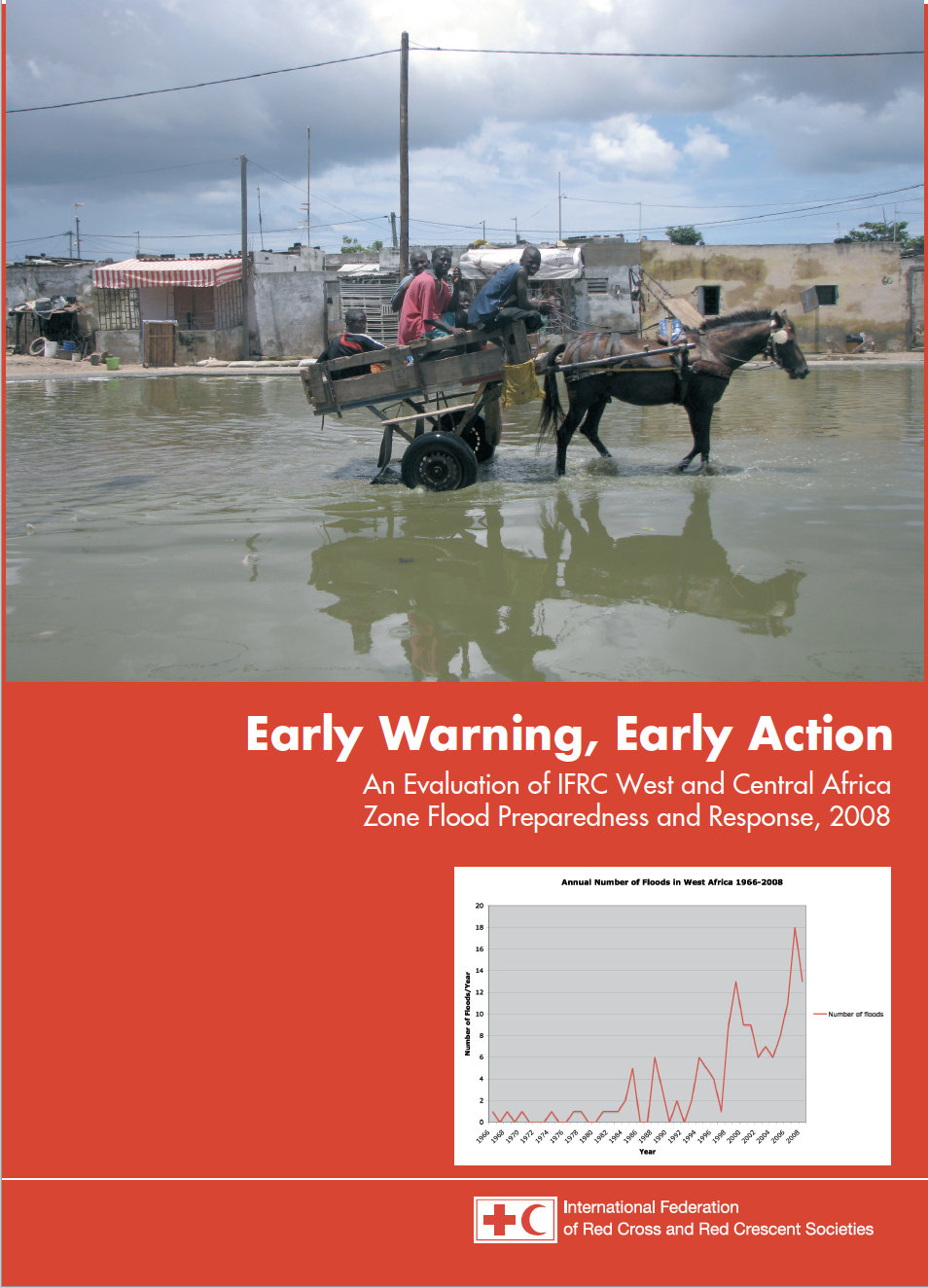
- 'Early Warning, Early Action': An Evaluation of IFRC West and Central Africa Zone Flood Preparedness and Response, 2008
- 'Early Warning, Early Action': The Experience in West African Floods, 2007-2008
(pdf, 1 MB) - West and Central Africa: flood alert confirmed

- West and Central Africa Zone invests in early warning measures

- Cyclone Nargis and talk of climate change
- Planting coconut palms in Indonesia

- Hurrican Paloma: early evacuation saved lives

- Cuba: Early warning saves lives in 'worst hurricane in 50 years'

- World Disasters Report 2009, chapter 3: Early warning, early action - bridging timescales
More information can be found at the 'early warning' section of the Links pages.