
Comprehensive guide to anticipatory action for IDPs and refugees centred on the MENA region
By the Climate Centre
The Climate Centre today published a comprehensive guide to anticipatory action for displaced people and refugees centred on the Middle East and North African region.
While displacement in MENA is caused predominantly by conflict, climate change is acting as a threat multiplier, according to the Practical guide to co-production for anticipatory action with IDPs/refugees, and the two together are driving complex patterns of displacement.
The guide includes “information, tools, short case studies and practical activities that provide actionable, useful and eventually impactful outcomes relating to co-production of AA for displaced people,” it says.
The guide also draws on lessons and case studies derived from the Istibak (“anticipate” in Arabic) project of the UK-funded Weather and Climate Information Services programme, which is aimed at strengthening the climate resilience of IDPs, refugee populations and host communities in Iraq and Yemen through forecast-based early action.
It was developed by Climate Centre experts in partnership with the IFRC, the British Red Cross and the World Food Programme.
Refugee and IDP camps are often placed in the most hazard-prone areas of countries, lacking in natural resources; they are often over-crowded, the shelters offered inadequate, with limited access to early warning systems, basic services and institutional protection.
‘A comprehensive learning experience’
The new guide says it’s designed to be integrated with the target audience’s existing work “in recognition that some or many elements discussed … are already at play within organizations working on anticipatory action, migration and displacement”.
It details “key elements of co-production, stakeholder mapping and building partnerships for effective anticipatory action, including … feasibility studies, risk assessments and early-warning systems [and] concludes with a checklist for implementation and recommendations for scaling up anticipatory action efforts for displaced populations.”
Also out today by the same team under WISER/Istibak, and with additional input from the UK Met Office, is a guide to training on impact-based forecasting – i.e. the shift from traditional forecasting of what the weather will be to what it will do.
The facilitation guide, also available in Arabic, will support trainers in delivering “a comprehensive learning experience on impact-based forecasting for anticipatory action [equipping them] with the foundational knowledge, practical tools and collaborative strategies necessary to co-develop and implement effective early-warning systems that help in taking timely, risk-informed decisions.”
The Middle East and North Africa had their hottest year on record in 2024, and the rate of warming is accelerating, accompanied by more intense heatwaves and droughts as well as extreme rainfall and storms, according to the first-ever report on MENA from the World Meteorological Organization, released last week
These climate threats combine with rapid urbanization, conflict, poverty, and population growth, highlighting the urgent need to build resilience, invest in risk reduction and water security, it added.
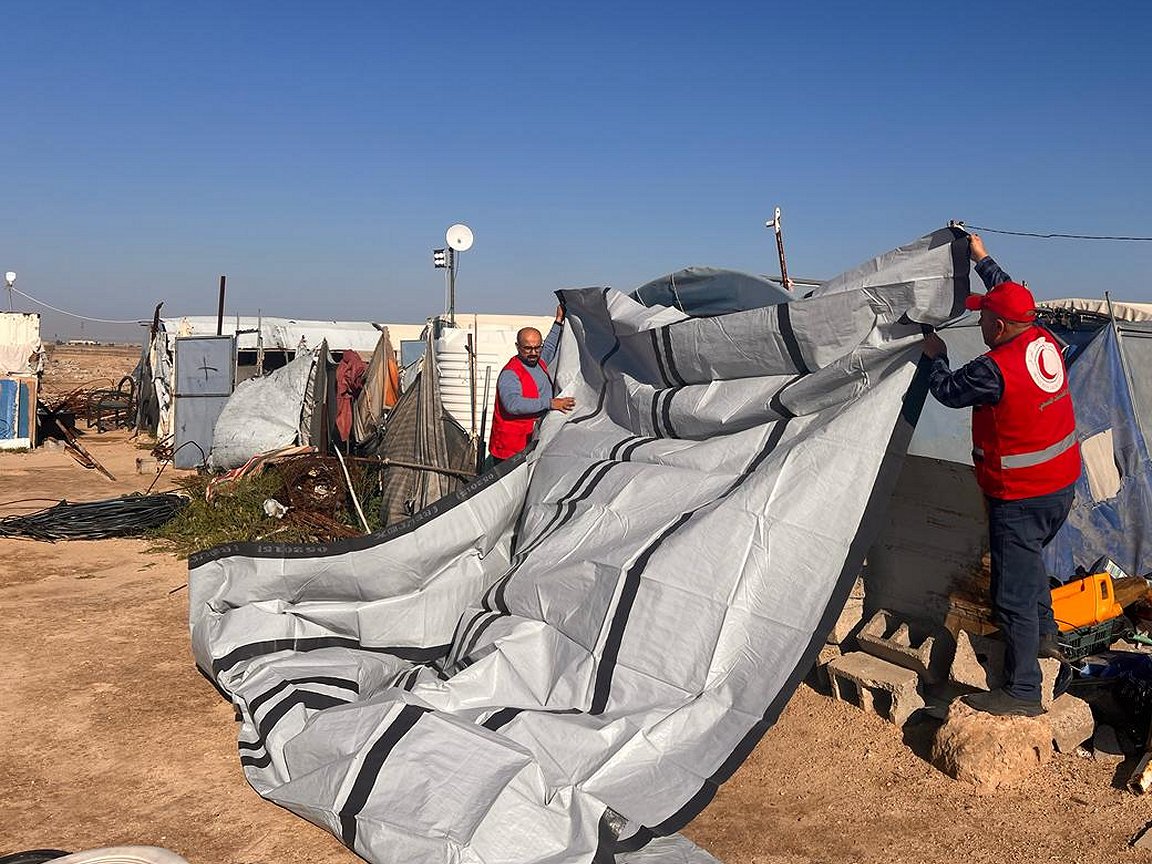
The new guide to anticipatory action for displaced people and refugees centred on MENA identified flash floods, droughts and sandstorms as the main hazards facing Iraq. Pictured (Anbar governorate), the aftermath of unprecedented heavy rains that lasted for three straight days last March across much of the country. (Photo: IRC via IFRC)