
‘This is a total transformation of the Australian summer’
By the Climate Centre
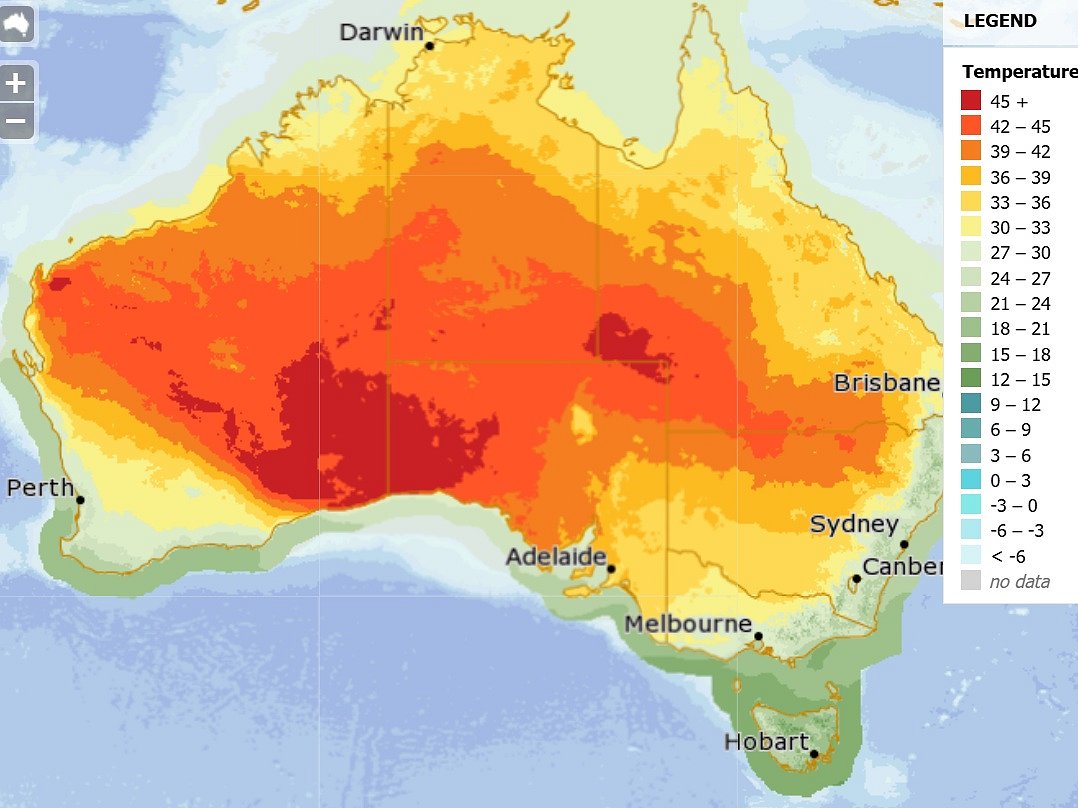
Australia’s Bureau of Meteorology said yesterday that potentially record-breaking heat is going to bring severe to extreme heatwave conditions as well as continuing catastrophic fire danger to parts of the south-east over the next week.
Top temperatures of 40°C for Melbourne, 43°C for Adelaide, and as much as 47°C for the city of Mildura in Victoria state are forecast.
“The combination of heat and wind, and particularly the very dry fuels from the heat that we’ve seen over previous weeks, that does give us a very high risk of bushfires taking off and being very hard to fight,” the BOM said.
The forecast comes as World Weather Attribution scientists released a rapid study finding that climate change made the latest Australian heatwave five times more likely.
“Once expected just four times a century, heat at this level is now likely every five years and will happen every two years without much stronger action to reduce emissions,” a WWA press release said Thursday.
‘The hottest place on Earth’
The study also found that the heatwave occurred even against the backdrop of a weak La Niña, which would usually bring cooler temperatures to much of the region, but the influence of fossil fuel emissions on temperatures far outweighed this effect.
Dr Sarah Perkins-Kirkpatrick, Professor of Climate Science, Fenner School of Environment and Society at the Australian National University, said: “This isn’t just a minor shift in the statistics; it is a total transformation of the Australian summer.
“What we once considered an extraordinary heat event is now something a primary school student today will likely experience several times before they finish high school.
“The 1.6°C of heat added by emissions turned a difficult week into a dangerous one. We are seeing the limits of human and ecological endurance being tested in real-time. As these events continue to move from being 1-in-25-year anomalies to regular occurrences, our window to adapt is closing. We are no longer talking about a distant future threat. This is now the reality of our climate today”.
The Australian Red Cross Register.Find.Reunite service was earlier this month open for several wildfire emergencies in Victoria state, while the National Society’s TeleRedi call centre was supporting others at risk, especially older people and those living with illness, disability or isolation.
Australia’s 9News reported on 8 January that Onslow Airport in the north of Western Australia state saw 49°C, making it “officially the hottest place on Earth” on that day.
A Bureau of Meteorology temperature chart issued yesterday, showing the entire centre of the country facing at least a 40°C heatwave. (Image: BOM)