
Blog: Simulating social protection as an engine for anticipatory action in Bangladesh
By Sayanti Sengupta, Climate Centre, and Anita Auerbach, German Red Cross
(This story was published first by the Anticipation Hub on Friday. Additional insights on the simulation are online from a volunteer, a social service officer, a Red Crescent programme officer and a beneficiary.)
A new study by the Bangladesh Red Crescent Society (BDRCS), the German Red Cross and the Climate Centre highlights how social protection systems can be used to scale up anticipatory action initiatives.
Drawing on findings from a simulation exercise in Bangladesh, it demonstrates that anticipatory cash transfers – which are delivered to at-risk communities before a hazard strikes – can be implemented effectively by working through existing social protection systems.
The simulation also identified some of the factors that can support this approach to cash transfers, such as data-sharing and digital inclusion, and addressing institutional barriers.
Strengthening the links between social protection systems and anticipatory action brings many benefits. For example, it can help to scale up anticipatory action initiatives, enhance their sustainability, and increase government ownership of such systems.
Meaningful early warnings
Shock-responsive social protection is key to achieving this. It enables existing social protection systems to adapt in response to climate and disaster risks by expanding their coverage, increasing the benefits people receive, or adjusting their timing so that support is provided ahead of shocks.
By building on established institutional arrangements, beneficiary registries and payment mechanisms, social protection systems offer a credible and efficient platform for scaling up anticipatory action initiatives beyond pilot projects.
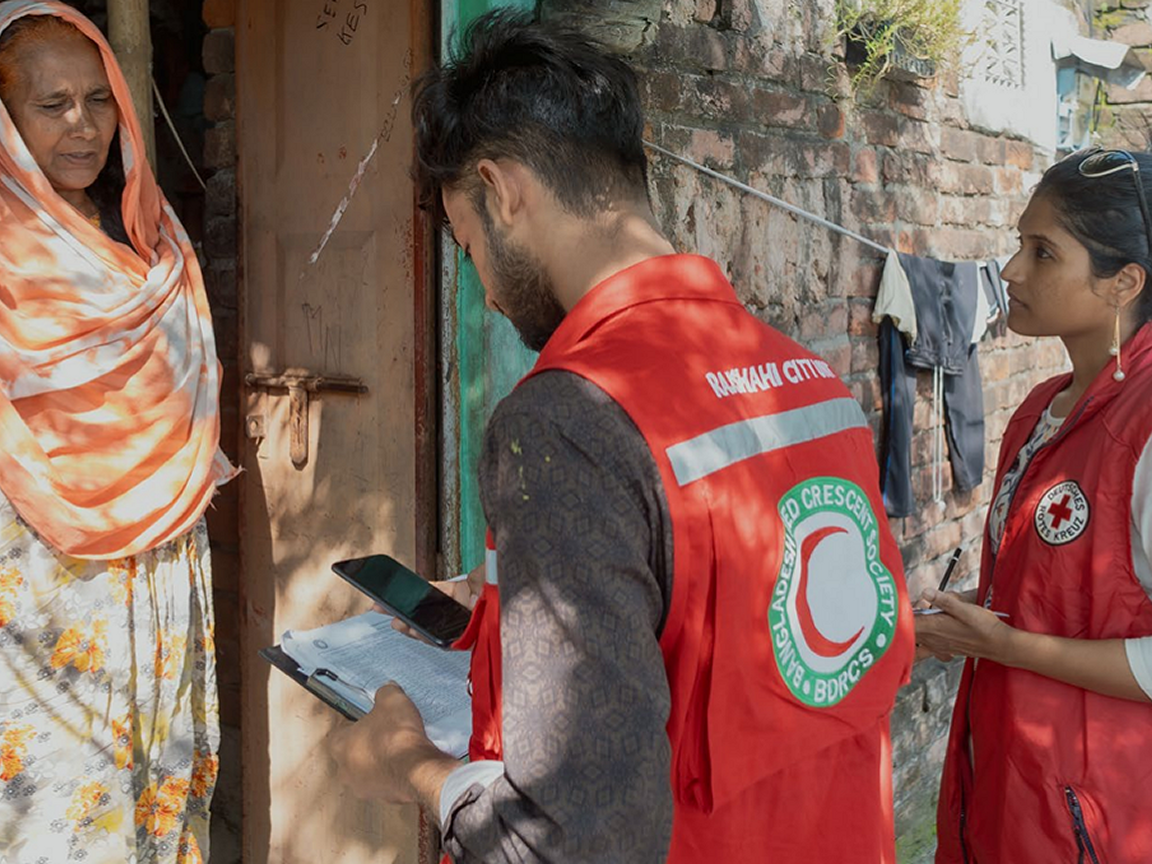
During the simulation in August 2025, the BDRCS used components of the existing social protection system to deliver cash transfers to 301 people in Ward 4 of Rajshahi city.
Each was already a recipient of the old-age allowance, and they received a top-up payment of 2,400 Bangladeshi taka (20 US dollars or 17 euros) through the simulation exercise. This was done in close collaboration with government actors working on social protection and disaster management.
The simulation also explored how climate-risk considerations can be incorporated into social protection systems and early warning mechanisms, among others.
For example, Rajshahi is at high risk from heatwaves, and the simulation looked at how social protection systems could deliver to people at risk meaningful early warnings and information on ways to use their cash assistance.
The exercise built on the BDRCS’s ongoing advocacy for the use of social protection systems as a way to deliver anticipatory cash transfers ahead of climate shocks. Since 2021 it has been engaged in continued consultations with the Ministry of Social Welfare and the Ministry of Disaster Management and Relief to test the feasibility of institutionalizing anticipatory mechanisms within social protection systems.
Highly exposed areas
The simulation exercise provided evidence that it is feasible for social protection systems to deliver anticipatory actions such as cash transfers in Rajshahi specifically, and more broadly in Bangladesh.
Pilots and simulations such as this can serve as a useful demonstration tool for governments, showing how anticipatory approaches can be financed and integrated into national systems, and indicating how they could be delivered at scale.
The anticipatory cash simulation in Rajshahi also confirmed several lessons about the challenges faced, and the successes achieved, during the long-term efforts to advocate for this approach:
*When social protection interventions are adjusted and used for climate shocks, they can facilitate anticipatory action and help manage climate risks.
*It is important to work with both national systems (e.g. beneficiary lists) and local actors (e.g. BDRCS volunteers) in areas highly exposed to hazards.
*There are high levels of community and government preparedness and appetite for using this approach, as well as strong political commitment to improve it.
*Strong partnerships with governments are essential for anticipatory interventions that seek to use social protection systems.
*Early information on imminent cash transfers is critical for recipients.
*The BDRCS is well placed to strengthen the government’s social protection systems.
Data collection during post-distribution monitoring in Ward 4, Rajshahi. A simulation demonstrates that anticipatory cash transfers delivered to at-risk communities before a hazard strikes can be implemented effectively by working through existing social protection systems. (Photo: BDRCS)