
Floods: Cash grant for South Africa follows multimillion emergency appeal for Mozambique
By the Climate Centre
The IFRC this week added South Africa to the list of flooded southern African nations for which it’s providing, or appealing for, international assistance amid what scientists have called exceptionally heavy and persistent rainfall that began at the end of December and intensified from early January.
South Africa declared a national state of disaster on 17 January in response to severe flooding in Limpopo and Mpumalanga provinces, marking a rapidly deteriorating situation that exceeded provincial response capacities.
The IFRC has allocated a humanitarian grant of just under half a million Swiss francs from its Disaster Response Emergency Fund to enable the local Red Cross to assist 10,000 affected people, roughly half the total across the two provinces as well as KwaZulu-Natal.
A IFRC-DREF sitrep published Sunday said 39 people have died in the floods and nearly 80 schools have been damaged.
The grant to the South African Red Cross follows by just a few days the expansion of assistance to Mozambique – by far the worst-affected country of those currently facing rainy-season floods – with an emergency appeal for 7 million CHF targeting 75,000 people.
Last week Mozambique’s Instituto Nacional de Gestão e Redução do Risco de Desastres said more than 650,000 people were affected across much of the country.
Some of the hardest-hit cities include the capital Maputo, crops have been destroyed and livestock killed, and there is an elevated risk of cholera and other water-borne diseases, the UN says.
A year’s rain in a few days
Climate change and La Niña have combined to create perfect storm in these two nations as well as Zimbabwe and Eswatini, World Weather Attribution scientists said.
Their study said downpours have been 40 per cent more intense since pre-industrial times, with some areas receiving over a year’s rain in a few days.
Mozambique is regarded as a pacesetter on anticipatory action, and the government activated its early action protocol for floods in the Licungo River Basin, Zambezia province, on 27 December.
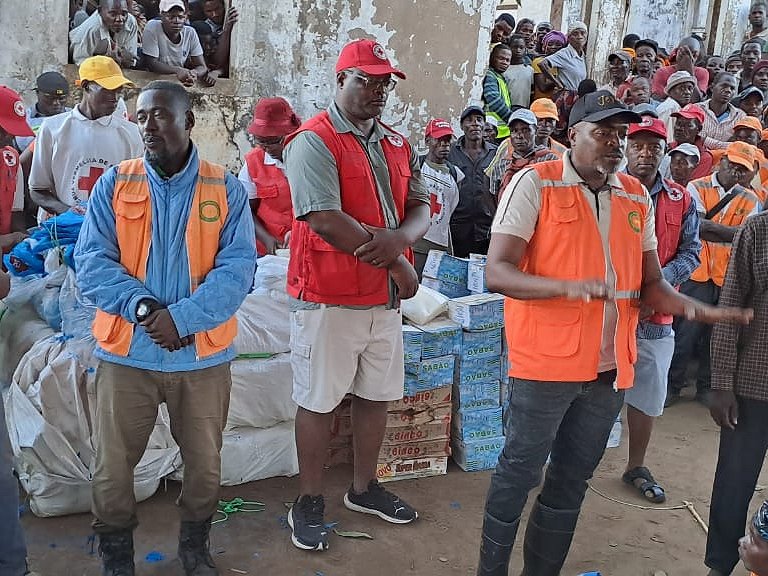
The Mozambique Red Cross and the WFP supported anticipatory actions, including the evacuation of more than 5,000 people in the province’s Maganja da Costa district, and early-warning messages that reached more than 500,000 (pictured).
On 8 January the Malawi government said 160,000 people had been affected by “storms, strong winds, flash floods and lightning” since the beginning of September in most of the country’s administrative areas, also including its capital Lilongwe.
The Malawi Red Cross acted early at the beginning of the year to provide assistance in Nkhotakota, where there were more than 20,000 people affected by the extreme weather, and shortly afterwards activated its simplified early action protocol following a forecast of more extremely heavy rainfall.
A further DREF grant of just over 185,000 CHF was made to Tanzania in mid-December after several rivers broke their banks and caused floods in low-lying parts of central Morogoro region, affecting more than 5,000.
The Mozambique Red Cross Society distributing government-generated early warning messages in Zambezia province as part of its early action protocol for floods: in total, more than 500,000 people were reached by the CVM with these messages, the IFRC reports. (Photo: Cruz Vermelha de Moçambique)