
Blog: Making adaptation in Europe ‘meaningful, actionable, durable’
By Fleur Monasso, Tesse de Boer, Anka Stankovic, Climate Centre, Netherlands
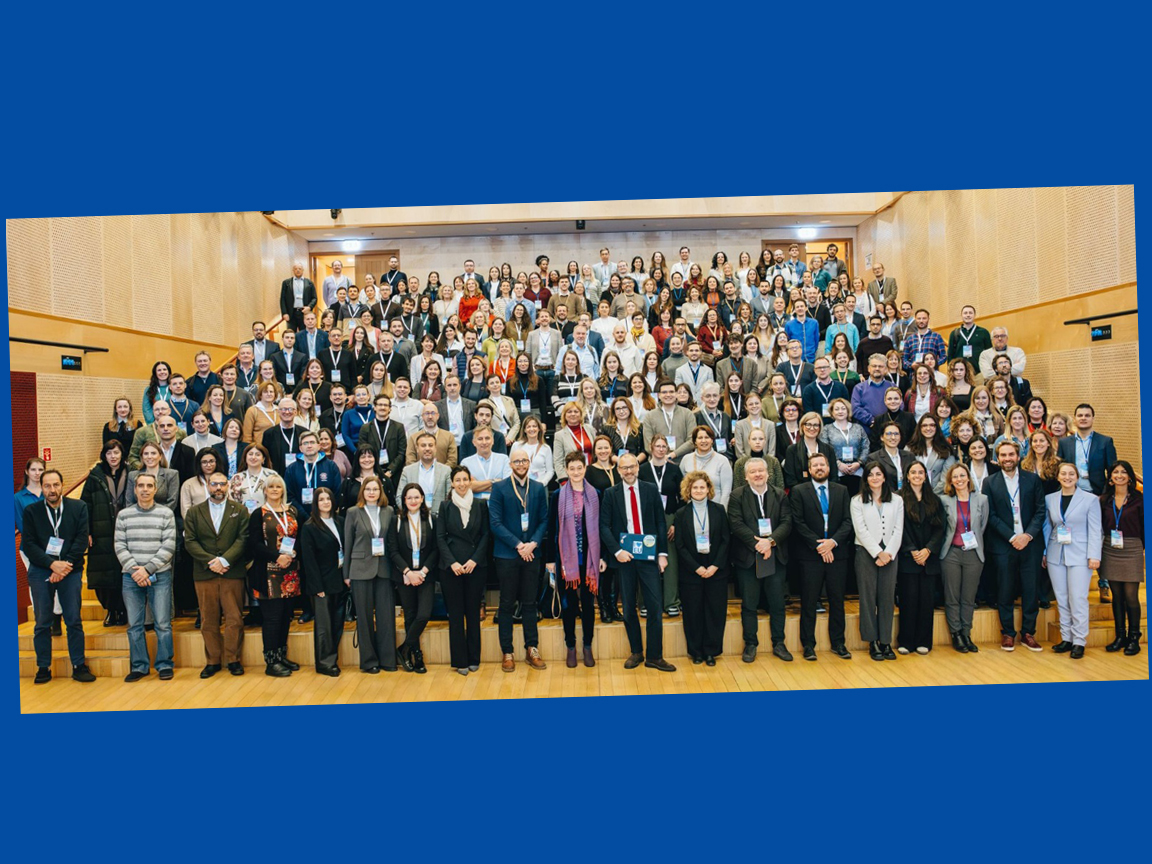
The European climate adaptation community met in Budapest last week 10–12 February for the Pathways2Resilience summit (pictured) to “reflect, connect, and create the future of the EU’s climate resilience journey”. Two hundred people celebrated the achievements of 38 regions and welcomed 62 new regions (shown in red and blue respectively here). P2R is an EU flagship programme within its mission on adaptation.
Our conversations in Budapest revealed a Europe in transition, where adaptation is becoming as much about people, relationships, and institutions as policies and data.
Representatives from the regions spoke about their eagerness to act, even when unsure how, about capacity stretched thin by competing political agendas, and about communities experiencing intensifying heatwaves, floods, storms and droughts.
One of the summit’s most energizing aspects was the richness of peer exchanges: people shared successes as well as lessons learned and uncertainties, and comparing approaches revealed new possibilities.
Participants were surprised, for example, to discover that heat is by far the most deadly climate risk in Europe, accounting for almost all deaths after any kind of extreme weather; yet even so, most regions dedicate less than 20 per cent of their adaptation work to helping people withstand and survive extreme heat.
Structure, training, finance
As consortium partners, the Climate Centre saw first-hand where local adaptation succeeds, where it struggles, and where humanitarian actors can help close the gaps.
P2R’s combination of structure, training and finance has enabled local authorities to design adaptation and investment plans with clarity and purpose; over the past 18 months, many have made rapid improvements, and progress is becoming tangible.
“We are on a good track to innovate, trying different solutions, but it is hard for us to scale up, which is dependent on finance,” said Orsolya Barsi, who runs host city Budapest’s Department of Climate and Environmental Affairs.
She continued: “Cities are laboratories for innovation. Resilience needs to be built on partnerships across sectors.”
These kinds of insights echoed the significant governance transformations (P2R visual platform) already taking place within the first P2R cohort.
*Western Greece, for example, has established a Climate Resilience Department and secured 1 million euros for a climate observatory.
*In Serbia, cross-sector working groups realised they all faced similar challenges, unlocking new collaboration.
*North Macedonia’s Sveti Nikole municipality created the country’s first integrated adaptation data system, now used to brief donors and ministries.
*London developed heat risk and finance plans that are influencing broader resilience thinking.
*Sweden used the programme to build networks that raise awareness and capacity on adaptation finance.
These stories suggest a Europe beginning to embed climate resilience in everyday governance.
You can only win by working together
Another clear pattern from Budapest was that adaptation succeeds when stakeholders are truly engaged.
Italy’s Marche region has gathered more than 200 stakeholders, including young people, residents, academics, and civil society, its team later observing that they had managed to talk to citizens and municipalities jointly, “which is not always easy”.
Cyprus designed a climate adaptation board game around the idea that you can only win by working together; Armenia used P2R tools to strengthen municipal capacity and influence national policy, while rural regions engaged with strong farm networks to overcome “consultation fatigue” and build trust.
All these examples pointed to the same conclusion: when people see themselves in the process, adaptation becomes more meaningful, actionable, and durable.
Even so, two challenges appeared again and again: how to map vulnerability and engage stakeholders, and establish whether adaptation plans are truly owned, relevant, and actionable.
And this is where the Red Cross comes in.
Our National Societies are uniquely well positioned to make science accessible to citizens, strengthen early warning systems and engagement with vulnerable communities, and support regions in turning plans into investment in resilience that covers the whole of society.
Whether in Western Greece, Ireland, or Slovenia, finance remains an issue. The European Investment Bank and the European Commission have encouraged regions to work with existing instruments, but gaps remain, and developing bankable projects remains one of Europe’s most pressing adaptation challenges.
A key achievement for last week’s Pathways to Resilience summit was matchmaking the first group of P2R regions with financial institutions, hopefully paving the way for others. (Photo: P2R via social media)