‘The well-being of humans is intrinsically linked to the health of our planet’
By the Climate Centre
The Swedish Red Cross says the argument it first made more than 40 years ago in its ground-breaking 1984 report Prevention is better than cure is vindicated by the experience of the present day.
Arguing that “the well-being of humans is intrinsically linked to the health of our planet”, Swedish Red Cross International Director Anders Pedersen says urgent action to stop the loss of biodiversity, restore ecosystems and mitigate and adapt to climate change is essential to prevent and alleviate human suffering.
A new SRC report published last week “outlines Swedish Red Cross ambition to step up response to growing humanitarian needs, support Red Cross and Red Crescent National Societies, and help people adapt to and reduce the impacts of the planetary crises,” Pedersen writes in an introduction.
“Humanity faces a choice: to react and respond to growing humanitarian needs, which is costly both in terms of human suffering and financial investments, or to invest more in prevention, which saves lives and scarce resources,” he adds.
The new report is called Protecting People, Preserving Planet, Swedish Red Cross Framework for Environmental and Climate Change Action.
‘Critical links’
“Today we see how climate-induced hazards create devastating consequences for the most vulnerable people, while the gap in global climate finances continues to increase,” Pedersen continues.
“Building on our extensive experience in disaster risk reduction, health, water, sanitation and hygiene, we will scale up our support for strengthened local capacity and resources for anticipatory actions that prevent and reduce impact on lives, livelihoods and humanitarian needs.”
The Swedish report carries five key messages on addressing the humanitarian consequences of climate change and environmental degradation.
Governments, firstly, should meet their commitments under the Paris Agreement and other international agreements by reducing emissions, scaling up global engagement, and mobilizing finance.
Together with humanitarians, secondly, they should prioritize locally led action by empowering vulnerable communities, “addressing critical links between climate change, displacement, migration, and public health”.
The same actors should scale up investments in anticipatory action and nature-based solutions, prioritizing early warning, disaster risk reduction, and preparedness.
The principle of “do no harm” should always apply, encompassing the integration of “environmentally responsible practices across all humanitarian operations”.
And lastly, the private sector and academia must “engage more actively in developing and shaping innovative solutions to address climate and environmental challenges impacting the most vulnerable.”
A green response
The Swedish Red Cross strategy for 2023–30 calls for reducing the humanitarian consequences of climate change and recognizing the disproportionate impact the climate crisis has on world’s poorest and most marginalized.
Protecting People, Preserving Planet outlines ten relevant Swedish programmes in (alphabetically) Bangladesh, the Democratic Republic of the Congo, Iraq, Lebanon, Liberia, Mozambique, Myanmar, Palestine, South Sudan, Sudan, with partners who include the Norwegian and Danish Refugee Councils.
In 1984 Prevention is better than cure contributed to setting the agenda for disaster risk reduction and was followed by a major programmatic initiative from the SRC.
The Swedish Red Cross launched the concept of Green Response within the Red Cross Red Crescent Movement in 2012 and has remained a leader in developing and implementing the concept ever since.
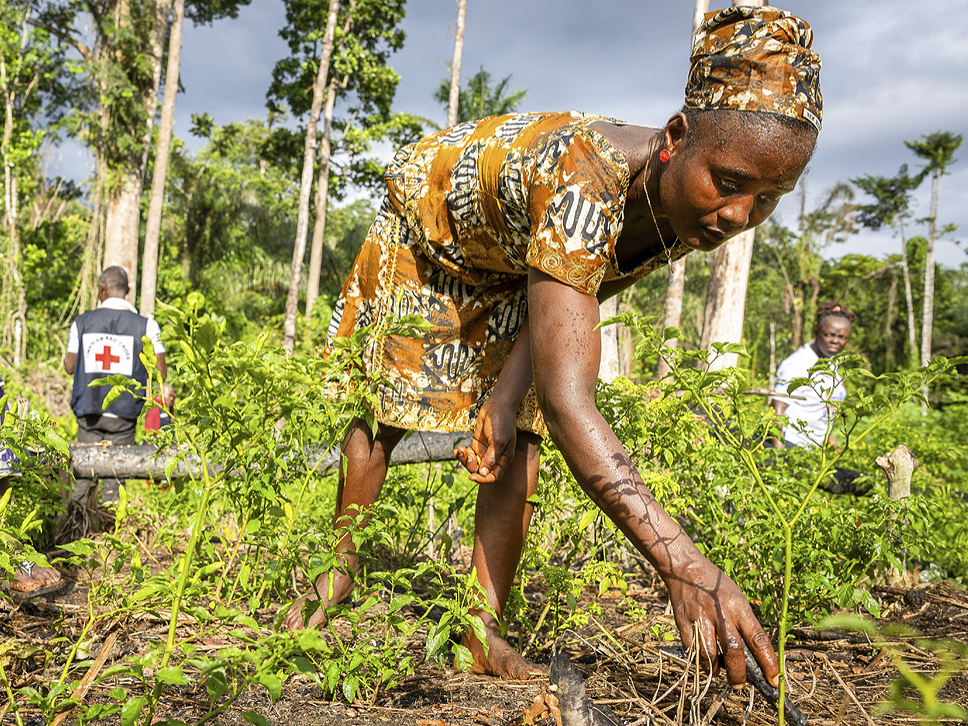
Half an hour’s walk into the rainforest outside the Liberian village of Podroken is its new community garden where chillies and eggplants thrive on cleared land. “We grow many different crops now … thanks to the Red Cross initiative. Before, we grew them individually, which made it very difficult when the harvest failed,” says Linda. The picture appears on the cover of a new report from the Swedish Red Cross, published last week. (Photo: Tomas Ärlemo/Swedish Red Cross)