
Blog: ‘Preparing for the future starts with having the tools to imagine (and draw) it’
By Renate Meyer, Climate Centre, South Africa
What would happen if a Category 5 tropical cyclone formed in the Mozambique Channel? What if cyclones began making landfall further down the coast of Southern Africa than they do today? And how would humanitarian systems cope if several climate-related shocks occurred in quick succession?
These were some of the questions explored during a series of workshops and a final full-team meeting held in May of the REPRESA project which focused on the cyclone and flood risk in Madagascar, Malawi and Mozambique.
The workshops brought together meteorological agencies, disaster management authorities, humanitarian organizations, researchers and community representatives to explore how future climate risks might unfold and what that means for preparedness and resilience.
With climate change altering the frequency, intensity and geography of weather extremes, people increasingly face risks that fall outside historical experience.
Alongside technical training on modelling floods and tropical cyclones, participants took part in interactive sessions on storylines and stress-testing led by the Climate Centre.
In recent years the Climate Centre has been developing or deploying these and other complementary approaches – including shorter-timeline scenario planning in Madagascar – to support those most vulnerable to climate change.
While storylines help partners imagine plausible futures and test their preparedness, the stress-testing component supports resilience in institutions, the Red Cross Red Crescent, NGOs and communities, through identifying stress points and windows of opportunity to improve how institutions might respond if hazards became more intense, occurred in unfamiliar locations, or happened in quick succession.
Plausible future events
For both meteorologists and practitioners, the approaches the Climate Centre is developing with partners are valuable both for short-term planning such as early action protocols and longer-term strategy.
In Malawi, participants used Cyclone Freddy as a starting point to discuss not only past impacts but imagine how future events could differ – and what actions could reduce risk before cyclones make landfall.
In Mozambique, participants from government ministries, meteorological services, disaster management agencies, universities, and humanitarian partners worked together to build a timeline stretching from today to 2100.
Along that timeline, they placed a series of plausible future events, from severe droughts and floods to more intense storms occurring in locations that have historically faced less risk. Participants then stepped into the future and told stories from the perspective of fictional characters whose lives were shaped by these events.
Through these characters, they explored how climate risks interact with age, disability, livelihoods, mobility and access to information.
As one participant reflected: “Imagination is a way to explore the future and make it ours.” Another noted that imagining future scenarios helps people find “more intuitive and powerful solutions” to climate adaptation challenges.
Evaluate information, navigate misinformation
Despite the diversity of experiences, participants repeatedly returned to two themes: education and trust. Many discussions focused on the need for stronger public understanding of cyclone risks, early warning systems and climate change.
Participants highlighted the importance of helping people understand not only what warnings mean, but also how to evaluate information and navigate misinformation circulating online.
Trust was equally important. Participants stressed the need for clearer communication about what actions people should take, where they should go during evacuations, and how warnings relate to previous events that communities have experienced.
With six months remaining in REPRESA, partners are focused on translating research into action. With ongoing engagements in all three countries and in global dialogues, planned outputs include a road map for sustaining collaboration after the project ends. A key lesson from REPRESA may be that preparing for the future starts with having the tools to be able to imagine it.
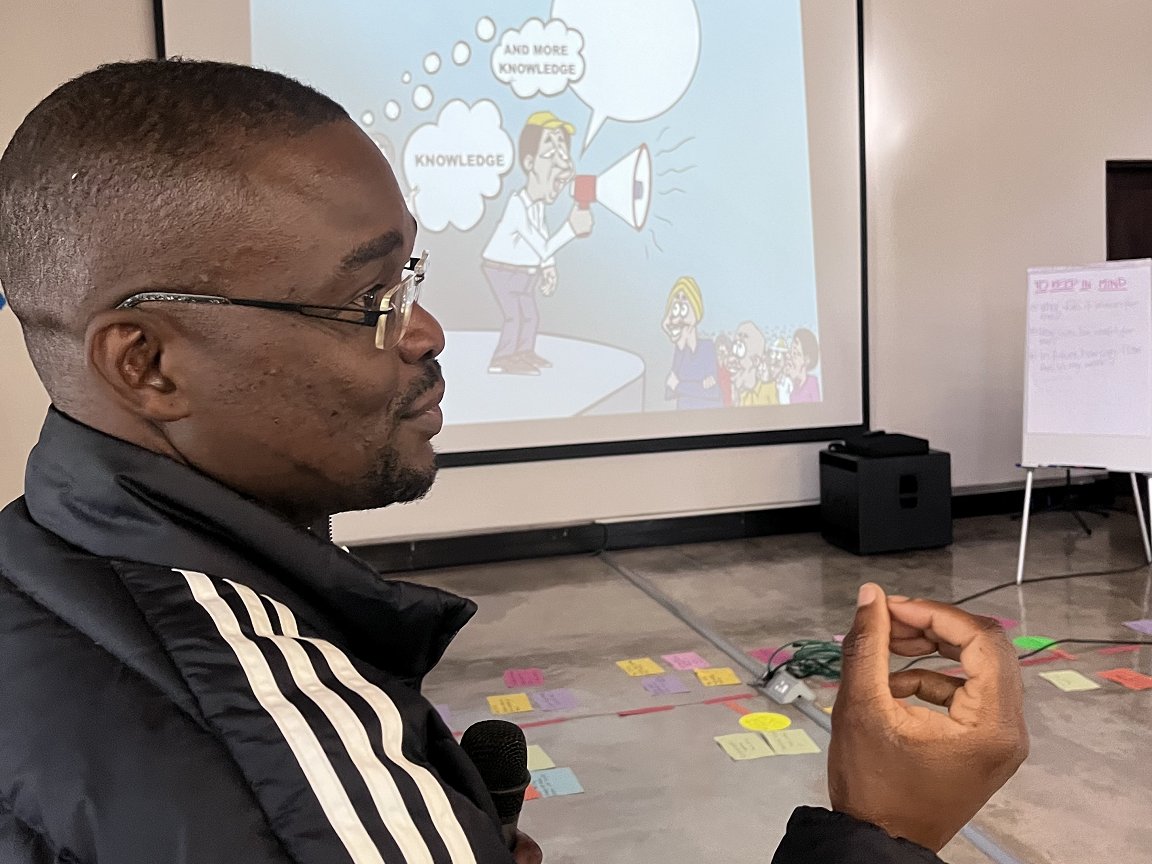
Cartoonist Bethuel Mangena, who is affiliated with the Climate Centre, attended the all-team REPRESA meeting and drew many of the ideas discussed. (Photo: Renate Meyer/Climate Centre)