
European heatwave shifts east
By the Climate Centre
The Czech weather service was today among those to forecast rising extreme temperatures – as high as 41°C in the west of the country – as the record-breaking heatwave that has been disrupting daily life in western Europe moves broadly east.
Germany and Poland could also see 40°C, according to forecasters quoted in media reports.
The heat is being driven by a blocked high-pressure system trapping hot air over Europe and drawing it up from the Sahara.
Across Europe – already established as the world’s fastest warming continent – the IFRC network has mobilized staff and volunteers to help communities beat the heat, including distributing water and setting up cooling spaces in cities, and going house-to-house to check on vulnerable people, especially the elderly.
Volunteers are also providing first aid and sharing practical, life-saving advice to help people protect themselves and those around them.
“We are urging people to stay connected to heat alerts and act on guidance from their local authority,” said Birgitte Ebbesen, IFRC Regional Director for Europe.
“Take a moment to check in on a neighbour, a family member, or anyone you know who could be more vulnerable. That simple act can save a life.”
Simple actions
Mary Friel, IFRC Climate Policy Senior Officer, added: “Extreme heat is now one of the defining humanitarian challenges of our time – a major public health-risk that demands action from people, institutions and governments alike.”
The IFRC network is ready to support governments and communities before, during, and after extreme heatwaves, an IFRC press release said Wednesday, while Red Cross Red Crescent volunteers are “reaching people who might otherwise remain isolated and unseen” during heatwaves.
*The Italian Red Cross is running a public awareness campaign and mobilizing volunteers to prioritize house visits with housebound older people and those in migration or informal settlements.
*The Spanish Red Cross is sharing simple actions that save lives, supporting cooling centres, and providing welfare calls.
*The French Red Cross has opened cooling centres in branches, increasing door-to-door visits, and working with local health services to coordinate efforts. It has also launched a nationwide campaign sharing simple advice on staying safe.
*The Swiss Red Cross is partnering with towns and cities to focus support on people over 75, through calls and home visits.
*British Red Cross volunteers are providing water, fans and other supplies in ten local community hubs in London providing cool spaces, and other emergency teams are on stand-by.
El Niño ‘had no role’
The UK Met Office yesterday issued a third daily red warning for extreme heat – the first time in the history of the current system that red warnings for extreme heat have been issued in the UK three days in a row.
Andy Page, Met Office Chief Meteorologist, said: “This exceptional spell of hot and humid weather will maintain its grip on the UK for a little longer … Significant disruption to daily life is likely and the public should take every effort to adapt their daily routines to cope with these levels of heat, which up to now have been extremely rare for the UK.”
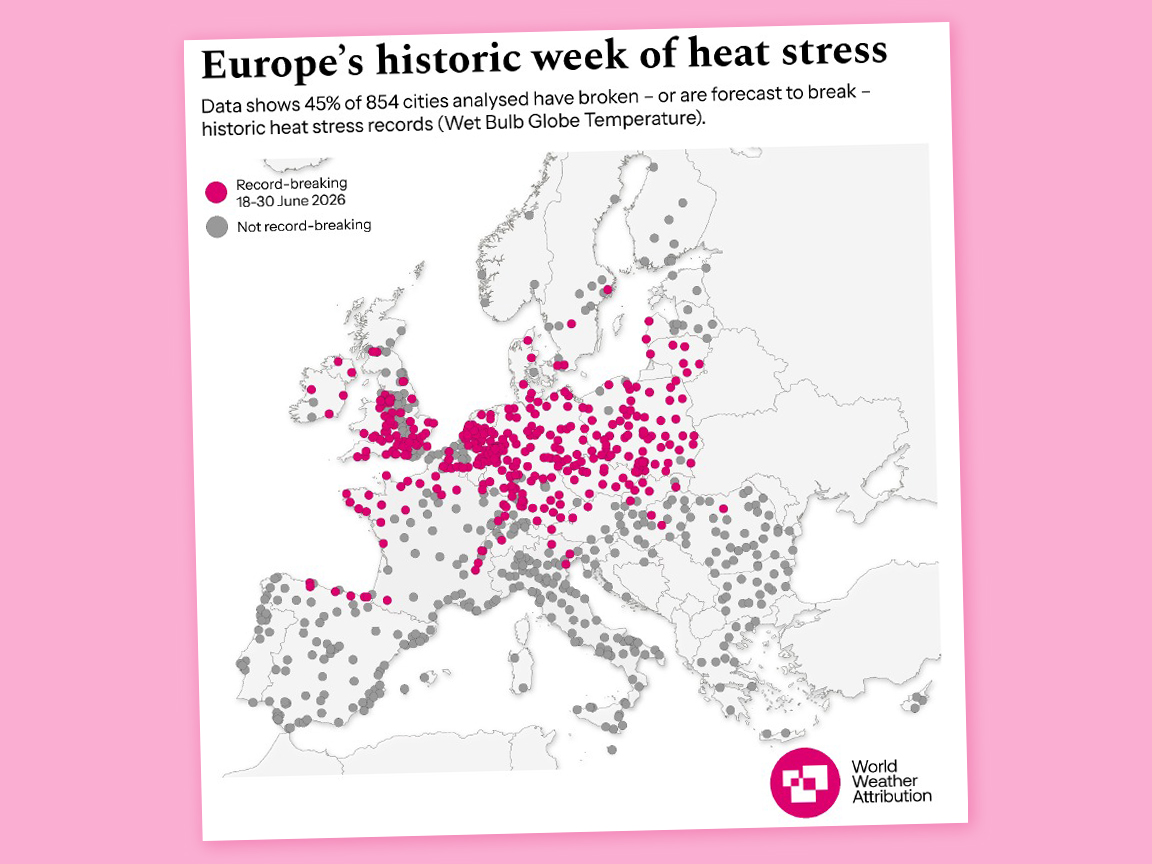
Also today, World Weather Attribution scientists said the record-breaking European heatwave would have been “virtually impossible just 50 years ago. Climate change is unequivocally to blame.”
“A staggering 45 per cent of cities analysed across 30 European countries (image) have already broken, or are predicted to break, their highest ever heat-stress levels,” their latest rapid study said. It also found that the current El Niño “had no role in driving the heat”.
The young suffering too
The Climate Centre’s Carolina Pereira Marghidan, a WWA team member, said today: “People in Europe are far more aware of heat risks than they were in the past, but awareness alone is not enough. Many people still live, work, and study in places that are not designed for the temperatures we are now experiencing.
“The Red Cross encourages people to follow local heat advice, seek cooler spaces where possible, drink plenty of water, and check on family, friends and neighbours who may be most at risk.”
She continued that “as temperatures continue to rise, we are seeing a growing gap between the pace of climate change and the pace of adaptation.
“Despite widespread heat warning systems and heat action plans across the continent, the heat continues to impact health, transport, energy systems and daily life. We need greater investment in heat-resilient homes, cities and infrastructure to keep people safe.”
The BBC quoted the French Health Minister, Stéphanie Rist, as saying there are now risks to young people as well as the elderly: “young people are also suffering from cardiac arrests”. The Paris ambulance service has seen four times more cardiac arrests than normal over a 24-hour period, Rist added, while stressing there were not yet confirmed figures for the number of deaths linked to the heatwave.
Image: WWA