Brief: Joined up work on climate- and conflict-related impacts in Niger
By the Climate Centre
How can humanitarians address the non-economic loss and damage arising from the climate crisis in fragile and conflict-affected states? That’s the question addressed in a new brief from the Climate Centre, published today, focusing on Niger and work there by the Nigerien and Danish Red Cross.
Niger has faced climate-related hazards, conflict, and high levels of displacement since at least 2015; floods have affected up to 200,000 people a year since 2012; political instability continues to impede the delivery of aid. As much as 5 per cent of Niger’s 25 million people were displaced just by disasters in 2024.
The Danish Red Cross has been working closely with the Nigerien Red Cross in the Niamey and Zinder regions, helping to foster social cohesion and increase resilience.
The effort prioritizes working “with and not for” local communities, the new brief says.
“This project helps address the main problem of limited resources,” the DRC focal point for migration in Niger explained.
“IDP and host community members share gardens [for example]: they plant and sell together and share the income. In the past, only one group had the resources, which was a problem.
“They also get to know each other and share questions and concerns. A kind of social activation of support happens with those gardens.”
In Zinder, the Nigerien Red Cross with DRC support works in primary healthcare, psychosocial needs, contact tracing, hygiene supplies and food.
The DRC also supports a mobile clinic in Niamey to reach migrants in informal settlements who otherwise lack access to healthcare.
‘IDP and host community members share gardens: they plant and sell together and share income’
Another project by the Nigerien Red Cross and the ICRC, Ecoresilience, was launched in 2023 and implemented in conflict-affected areas, addressing short-term needs of displaced and host communities.
The Climate Centre – in collaboration with the DRC, the Danish Institute for International Studies and the Niger Red Cross – has also produced a story map focused on the Tillabéri region, presenting key findings from a related DIIS study.
In Niger and other countries affected by conflict and climate change, neither usually limited government support nor humanitarian assistance alone can address expanding needs.
But the Global Goal on Adaptation opens up some pathways for Niger and other African countries to increase advocacy, planning and adaptation – but only if climate finance is made available.
The new research points towards the importance of bridging humanitarianism, climate adaptation, peacebuilding and displacement programming to promote joined-up programming and targeted support.
The work, it finds, should ensure: that host communities are embedded in humanitarian work with displaced people as both providers and recipients of assistance; that social dynamics are understood often to be “borne out of situations of grief” meaning psychosocial care is needed; and that finance for adaptation and loss and damage “should embed conflict sensitivity to allow funding in settings of fragility, conflict and violence, supported by flexible policies and guidance.”
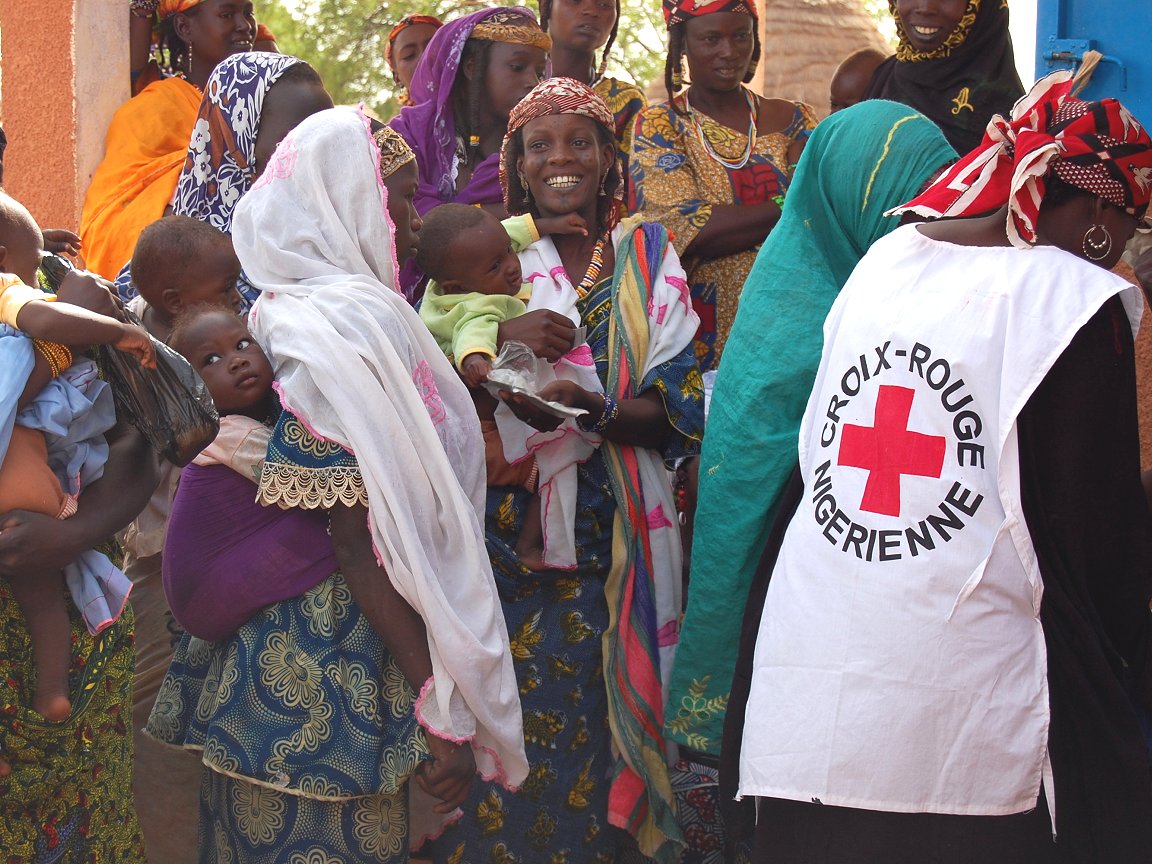
Nigerienne mothers and their children at the Red Cross nutrition centre at Koffo village, Dosso region. Niger Red Cross volunteers went from village to village to find malnourished children and encourage them to attend the centre. The most recent Danish supported work in Niger centres on fostering social cohesion and resilience amid climate- and conflict-related impacts. (File photo: Julie Lorenzen, Danish Red Cross)