
Supporting early warning in the Middle East and North Africa: lessons from WISER
By the Climate Centre
In fragile settings where “extreme weather does not stop for conflict”, humanitarian organizations have an especially important role in bridging the gap between the national meteorological and hydrological services that generate warnings and the communities that need them. Such complex settings demand adaptations to standard ways of working from both donors and implementing partners, yet practical guidance remains limited.
This is among the chief conclusions of new Climate Centre research that identifies ways to deliver early warning and anticipatory action that arise from the experience of the UK Met Office Weather and Climate Information Services (WISER) programme in the Middle East and North Africa.
‘Highly challenging operational environment’
The research was published by the Climate Centre in June in two sections: a main report and a separate summary of recommendations.
The UK-supported WISER programme was designed to address the gap between forecasting and the people who use it, “working to strengthen the generation and use of weather and climate information, including impact-based forecasting,” the report says.
“In the Middle East and North Africa, WISER has done this in a highly challenging operational environment, in a region that had virtually no formal experience of anticipatory action programming.”
It concludes that flexibility in funding and implementation are vital to effective early warning in fragile and conflict settings.
‘Adaptive management’
“As conflict escalates and other changes in the operational environment affect the feasibility of various project components, adaptive management approaches are necessary to reprioritize activities and find new ways to achieve programme objectives,” it adds.
Small-scale projects led by national meteorological and hydrological services and civil society “emerged as the most impactful modality in WISER MENA, achieving significant impact for local communities with very limited resources.”
With currently limited capacity, WISER’s successes in the Middle East and North Africa centre on capacity-building among local met services and other stakeholders, as well as the small-grant projects.
The experience and recommendations detailed by the Climate Centre authors “encourage reflections on established grant management processes and room for innovation to make programme design more flexible” in regions like MENA.
The first phase of WISER MENA lasted from 2022 until early 2026, and projects implemented under it include Istibak (Arabic for anticipation), delivered by the British Red Cross, the IFRC, the World Food Programme and Climate Centre in Iraq, Palestine, Syria and Yemen.
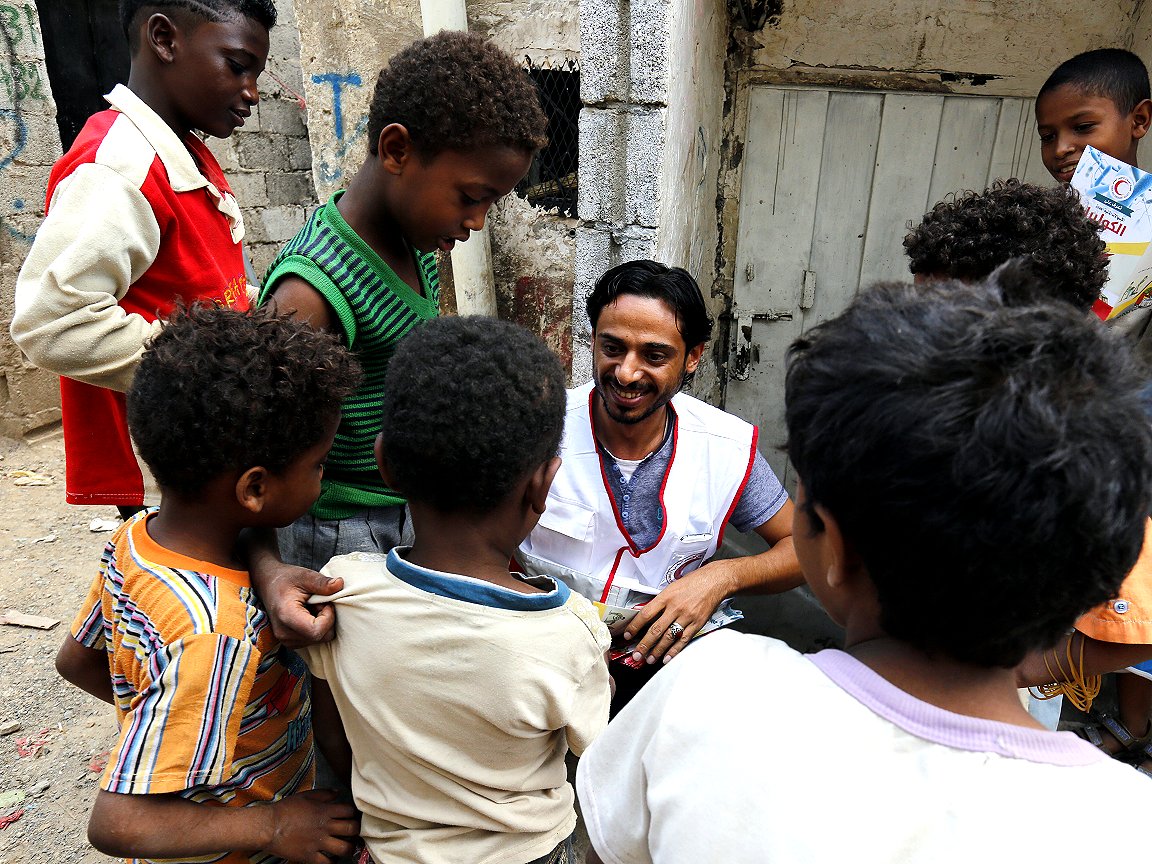
Yemen Red Crescent volunteer Majed demonstrates the importance of thorough handwashing as a precaution against cholera. Yemen continues to face one of the world’s most protracted humanitarian crises “driven by conflict, economic deterioration, disease outbreaks including cholera, and climate-related hazards,” the IFRC said, issuing a humanitarian grant of half a million Swiss francs for widespread floods in March. “Many of the affected areas are located near front lines, further elevating risks associated with landmines and unexploded ordnance,” it added. (File photo: Yemen Red Crescent via IFRC)