
IFRC launches 25m Swiss franc emergency appeal for Nepal flash flood
By the IFRC
(This story is an IFRC press release issued from Kathmandu, Kuala Lumpur and Geneva on Thursday.)
The IFRC has launched an emergency appeal for 25 million Swiss francs to support the Nepal Red Cross Society’s response to the devastating flash floods that struck northern Nepal, just a day after releasing nearly 1 million CHF in emergency funding to support the immediate lifesaving response.
Current estimates suggest around 93,000 people may have been affected, while assessments continue in hard-to-reach areas.
Many homes have been destroyed or severely damaged, and multiple bridges have been washed away and major roads damaged, cutting off some of the worst-affected communities.
The remoteness of the affected areas, combined with damaged infrastructure, is making it harder both to assess the full scale of the disaster and to deliver assistance to people who need it most.
IFRC Secretary General Jagan Chapagain said: “The IFRC Emergency appeal is a critical step to support the communities affected, focusing not only on the emergency response, but also on the mid and long-term recovery.
“While we are getting a clearer picture of the scale of devastation, we know that entire villages were washed away and needs will grow in the coming hours and days.
“Communities that have lost homes and livelihoods will need sustained support as they recover and rebuild. We call on the international community to show solidarity in the months to come.”
IFRC mobilizes entire global network
The 24-month IFRC emergency appeal will support the Nepal Red Cross response across shelter, cash assistance, health, household relief items, water, sanitation and hygiene, mental health and psychosocial support, and restoring family links.
The appeal has a strong focus not only on meeting immediate humanitarian needs, but also on supporting medium- and longer-term recovery.
The IFRC has immediately mobilized its entire global network to support Nepal Red Cross and will adapt the response as further information becomes available.
Nepal Red Cross teams have been responding since the immediate aftermath of the disaster, providing food and water and distributing emergency supplies including tarpaulins, blankets, first aid kits, stretchers, emergency WASH kits and body bags.
Communication with teams in affected areas has been difficult due to limited phone signals, and additional teams are being mobilised to support those already on the ground.
The Climate Centre’s Liz Stephens writes: The exact sequence of events that caused this disaster is not clear and may not be for some time, but careful analysis of before and after images suggests part of a glacier collapsed high up in the Himalayas in a border area.
A giant ice-rock avalanche then appears to have blocked the Lhende Khola river, but this natural dam of debris quickly failed and led to the catastrophic and extremely sudden flooding downstream; the avalanche will have picked up more material as it travelled down the mountain, including massive boulders as graphic social media clips illustrate (Nepal police video).
Very unstable landscape
People tend to think of flash floods as caused by heavy rainfall, but in Nepal and other mountainous regions they can also result from complex chains of hazards, including landslides, avalanches and – although not thought to be the cause of this event – glacial lake outbursts; the complexity makes early warning especially difficult.
The flood is likely to have caused considerable erosion, undercutting slopes as it travelled downstream, leaving behind a very unstable landscape.
Scientists in the region will be concerned that the initial avalanche-flood could lead to more dangerous landslides and unstable debris-dams in the coming days.
Quoting the most recent IPCC assessment of the global climate, the IFRC-Climate Centre Future Fit report published earlier this year says that in mountainous environments, there is high confidence that as climate change leads to more heatwaves, glacial retreat and melting permafrost, it will drive hazards such as landslides and glacial lake outbursts, increasing the potential for complex cascading events.
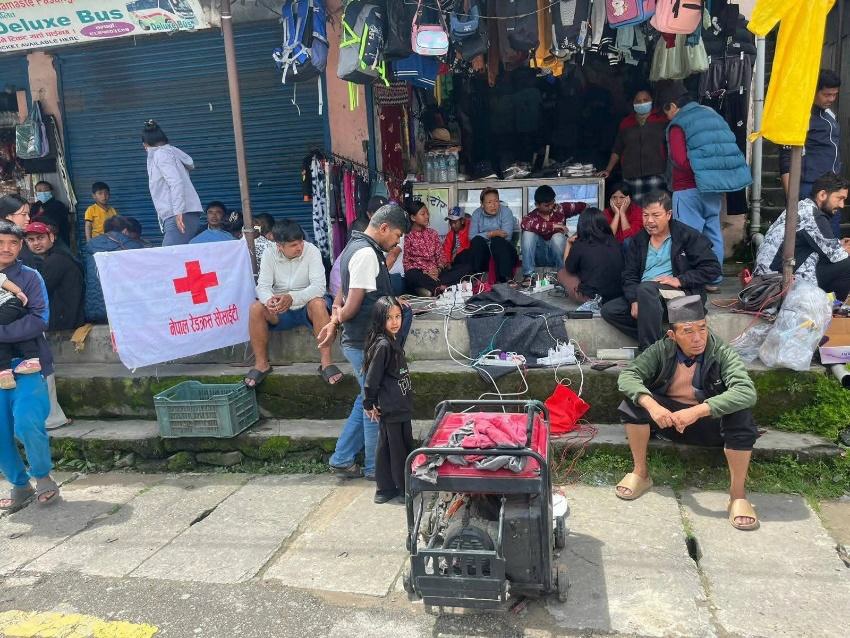
Nepal Red Cross teams have been responding since the immediate aftermath of the disaster, providing food and water and distributing emergency supplies including tarpaulins, blankets, first aid kits, stretchers, emergency WASH kits and body bags. In the picture, people in the small district of Rasuwa charge their phones from a generator brough in by the Red Cross who arrived soon after the only road was reopened on Monday. There had been no power up to then, but now facilities are starting to work. (Photo: David Fisher/IFRC)