
UN General Assembly flags ‘cumulative, severe and irreversible risks’ of rising sea-levels
By the Climate Centre
The United Nations General Assembly in New York yesterday adopted a landmark declaration on rising sea-levels, saying that “cumulative, severe and irreversible risks demand stronger international cooperation and urgent, coordinated action.”
The declaration stresses the need to boost disaster risk reduction, availability of data, risk assessments, early warning systems, and long-term planning and adaptation.
At the end of last year, the global mean sea level was around 11cm higher than in January 1993, according to WMO’s State of the Global Climate 2025.
UN Secretary-General António Guterres said yesterday: “Sea-level rise reaches far beyond the environment. It is a threat multiplier – battering economies, trade, infrastructure, and food systems.
“Around 770 million people – nearly one-tenth of humanity – live less than five metres above the high-tide line. For them, every centimetre matters. Without significant adaptation and mitigation, the risks facing coastal cities and communities are projected to increase at least tenfold by 2100.”
The declaration was adopted by acclamation at the high-level segment of the 81st General Assembly. Session president Khalilur Rahman said seas around New York City are projected to rise by up to 1.3 metres by the end of the century and by far more if Antarctic ice melts rapidly. That would be enough to turn the Assembly hall at UNHQ into “a very large wading pool”.
‘Gaps’
“Understanding how sea level is changing, and what this means locally, depends on sustained observations – including tide gauges, satellites, ocean heat content, cryosphere and land-water changes, and measurements of vertical land movement, alongside the meteorological observations needed to predict storms and coastal flooding,” the World Meteorological Organization said in a statement welcoming the declaration.
“Yet significant gaps remain, particularly across the oceans, in small island developing states and in other vulnerable coastal regions. These are not simply gaps in scientific knowledge. There are gaps in our collective ability to assess risk, prepare, and make informed decisions.”
In 2021, the IFRC reported that people living in the world’s coastal regions are facing multiple and disproportionate risks from climate change: sea levels are rising, floods are becoming more severe, storms and cyclones are intensifying, and storm surges reach further inland. Large areas are becoming uninhabitable, according to Turning the Tide. Adapting to climate change in coastal communities, and millions of people have been or will be forced to leave their homes.
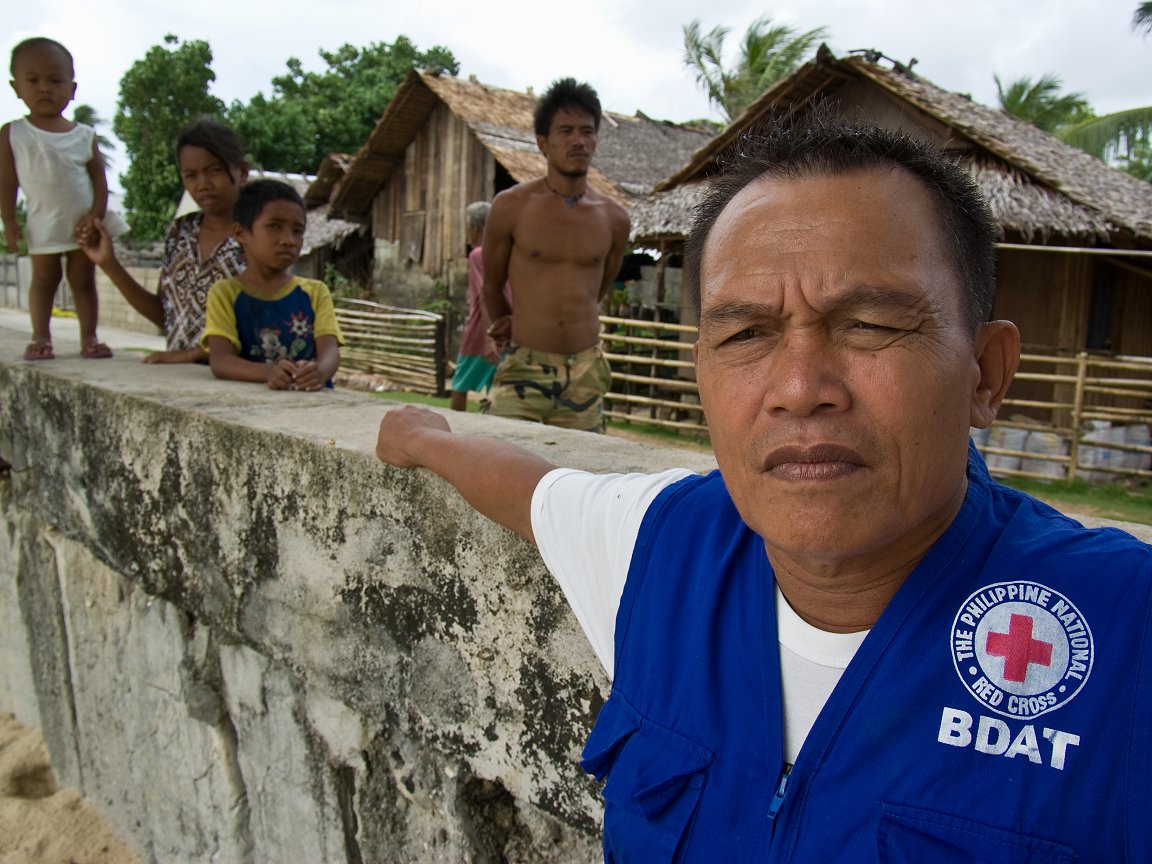
Philippine Red Cross volunteer Maximino Virtudazo, 59, helped build a sea wall to protect Burgos village on Siargao Island behind him. Since 2001 the 230m concrete barrier has held back numerous flood surges caused by heavy rains and typhoons, but rising sea-levels in the Pacific are testing it to its limits. (File photo: PRC via IFRC)