IFRC unveils 2026 Global Plan centred on local action to address humanitarian need
By the Climate Centre
(The full IFRC Global Plan for 2026 will be published next month; the Climate Centre’s own strategy taking it to 2030 will also be published in January.)
The IFRC Friday launched a summary of its Global Plan for 2026, outlining its priorities for the coming year as humanitarian needs reach unprecedented levels and funding shrinks, the IFRC said in a press release from Geneva.
“The plan highlights the urgent challenges facing communities worldwide, from more frequent climate-related disasters to protracted conflicts, rising displacement, health emergencies and growing vulnerabilities,” it added.
“In many crises, Red Cross and Red Crescent staff and volunteers are increasingly the only humanitarians still present as other actors scale down or leave.”
“Humanitarian needs are rising, challenges are growing and funding is shrinking. Many organizations have to leave communities just when they are needed most. Not us,” IFRC Secretary General Jagan Chapagain told a meeting at the IFRC secretariat office in Geneva. The IFRC network is local everywhere, and in 2026 that is not going to change.”
The IFRC network’s total funding requirement next year is 3.4 billion Swiss francs, with key areas of investment to include disasters and crises, health and well-being, migration and displacement, climate and environment, values, power and inclusion, emergency appeals, and special funds such as IFRC-DREF and the National Society Investment Alliance.
‘The IFRC network is local everywhere,
and that’s not going to change’
The IFRC will channel 75 per cent of all internationally mobilized resources to the national level, the press release continued, to “strengthen National Societies’ ability to lead in emergencies, expand volunteer networks and deepen accountability to affected communities.”
The executive summary published Friday notes that the impact of climate change is intensifying, “putting communities all over the world at risk of storms, extreme heat, drought and flooding.”
Among the IFRC’s large-scale platforms now earmarked for reinforcement are the Global Climate Resilience Programme, the Digital Transformation Impact Platform, and the new Global Migration and Displacement Platform.
The summary adds: “Our scalable, evidence-based programming – including predictive analytics and anticipatory action, digital tools, epidemic and pandemic preparedness, and climate-smart programming – ensures that every dollar spent contributes directly to saving lives, restoring dignity, and building long-term community and National Society resilience.”
Protecting humanitarian personnel to deliver effectively on our mandate will continue to be a key priority for the IFRC next year: 57 Red Cross and Red Crescent staff and volunteers were killed in the line of duty in the past two years.
“With the Global Plan 2026, the IFRC renews its commitment to being local everywhere, ensuring that communities have trusted support close to home when it matters most – and we invite our donors and partners to fund the plan,” the IFRC press release says, adding that unearmarked funding will be especially important in 2026 to anchor locally led action, sustain core services and support National Societies on the front lines of need.
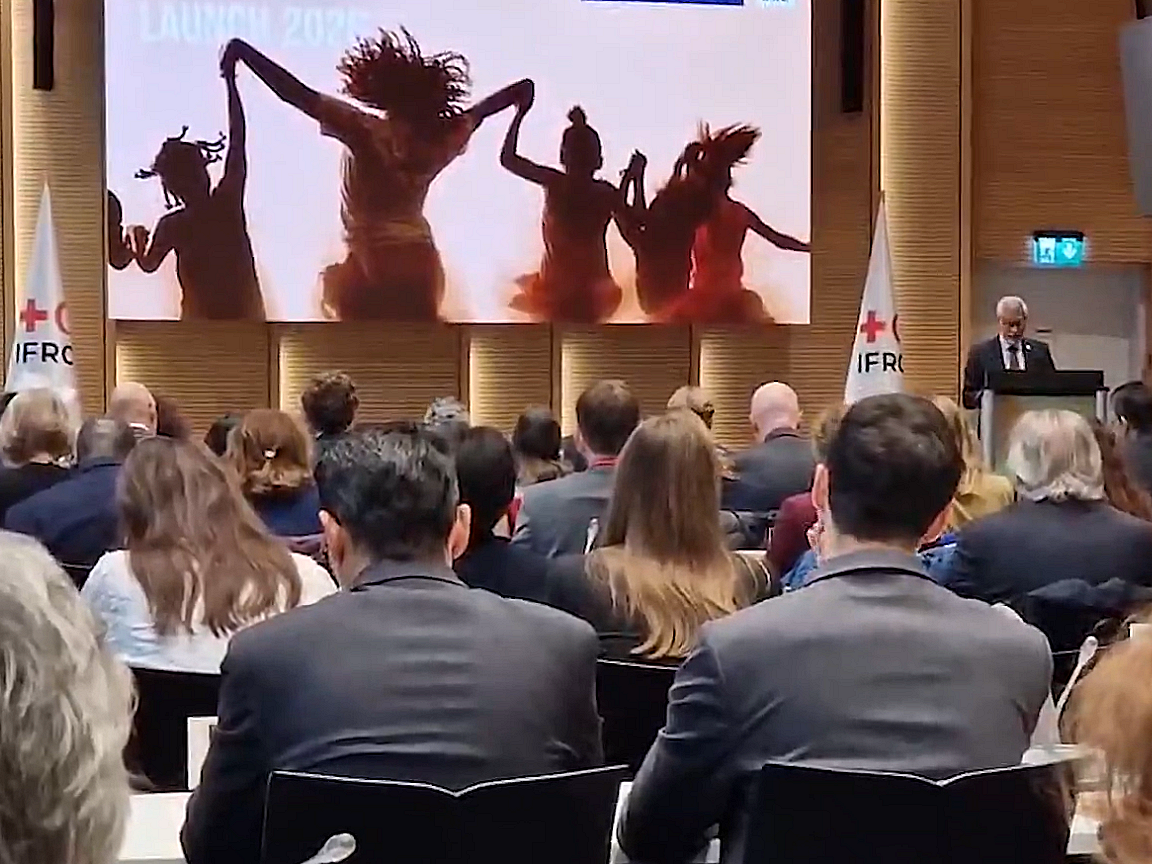
Jagan Chapagain launches the summary of the IFRC Global Plan 2026 in Geneva last week, and behind him the image used to illustrate it. (Image: IFRC)