
Odds shorten on El Niño starting later this year
By the Climate Centre
Climate models and forecasters are this week coalescing on predictions – specifically put at a 62 per cent probability by US scientists – of an El Niño developing during June to August and strengthening through the year.
Media outlets are speaking of the potential for a “super El Niño”, although this is not a recognized scientific category.
Scientists at NOAA’s Climate Prediction Center last month said that if an El Niño forms, “the potential strength remains very uncertain, with a 1-in-3 chance that it would be ‘strong’ during October-December 2026.”
They pointed out that forecasts are relatively less accurate at this time of year – referred to by meteorologists as the “spring predictability barrier” – but added that “increasing odds of El Niño are supported by the large amount of heat in the sub-surface ocean and the expected weakening of the low-level trade winds.
The NOAA forecast is due to be updated later this week.
Australian television Thursday quoted the country’s Bureau of Meteorology as saying that “while the Pacific Ocean is in a neutral state set to last until at least late [in the southern] autumn, there are strong signs El Niño could emerge later this year
“While sea surface temperatures are currently near average at the surface of the tropical Pacific Ocean, there is a large pool of abnormally warm water building beneath the surface.”
Shifts in ocean temperatures across the Pacific under El Niño conditions result in higher than normal global air temperatures while La Niña tends to have a cooling effect.
‘Decision-making’
Natural El Niño and La Niña cycles are taking place in the context of human-induced climate change, which is “increasing global temperatures in the long-term, exacerbating extreme weather and climate events, and impacting seasonal rainfall and temperature patterns,” the World Meteorological Organization said last month.
WMO Secretary-General Celeste Saulo said: “The WMO community will be carefully monitoring conditions in the coming months to inform decision-making. The most recent El Niño in 2023–24 was one of the five strongest on record and it played a role in the record global temperatures we saw in 2024.”
“Seasonal forecasts for El Niño and La Niña help us avert millions of dollars in economic losses and are essential planning tools for climate-sensitive sectors like agriculture, health, energy and water management. They are also a key part of the climate intelligence provided by WMO to support humanitarian operations and disaster risk management, and thus save lives.”
Climate Centre science lead Chris Jack said today: “Attributing climate extremes to El Niño is not always clear as there can be multiple contributing factors and each El Niño can unfold differently.
“Analysis has shown that in Southern Africa, the 2023–24 El Niño contributed to some of the worst drought conditions in 40 years across parts of Zambia, Malawi and Zimbabwe, driving crop loses and severe food insecurity.
“Other extremes including higher than normal rainfall, and temperature extremes in many regions around the world, have also been attributed to that episode.”
That El Niño peaked between November 2023 and January 2024 at about 2.0°C above the 1991 to 2020 baseline in the relevant Pacific region, the World Meteorological Organization said, making it one of the five strongest ever recorded.
‘Are we better prepared?’
Also Thursday, the latest edition of the Outrage+Optmism climate podcast noted that “the last major El Niño brought record heat, crop failures, flooding and deepening food insecurity across large parts of the world.”
“This time,” asked hosts Tom Rivett-Carnac and Paul Dickinson, “the question is not only what may be coming, but whether we are any better prepared to act on the warning.”
The Climate Centre’s Andrew Kruczkiewicz, a lecturer at Columbia University specializing in remote sensing and early warning and a guest on the show, told the podcast that “once we reach June and especially July, we are through the spring predictability barrier [with] enhanced confidence in what the seasonal climate forecasts are indicating for the [northern] fall to winter periods, where we traditionally see the strongest El Niño occurrence and also the strongest impacts from El Niño.
“We must prepare and we must start talking about preparation across sectors … there certainly should be enhanced discussion.”
Kruczkiewicz continued: “Now is an opportunity to reflect on the progress that’s being made within what we call the anticipatory action community, and perhaps identify mechanisms in standard operating procedures within the Red Cross Road Crescent Movement.“
Addressing the question of the lack of certainty in forecasting, Kruczkiewicz said: “Uncertainty is not a bad word; uncertainty is a concept that allows us to make statements about the future.”
The Climate Centre late last month announced a major forthcoming report on making early action for climate-related hazards fit for the future.
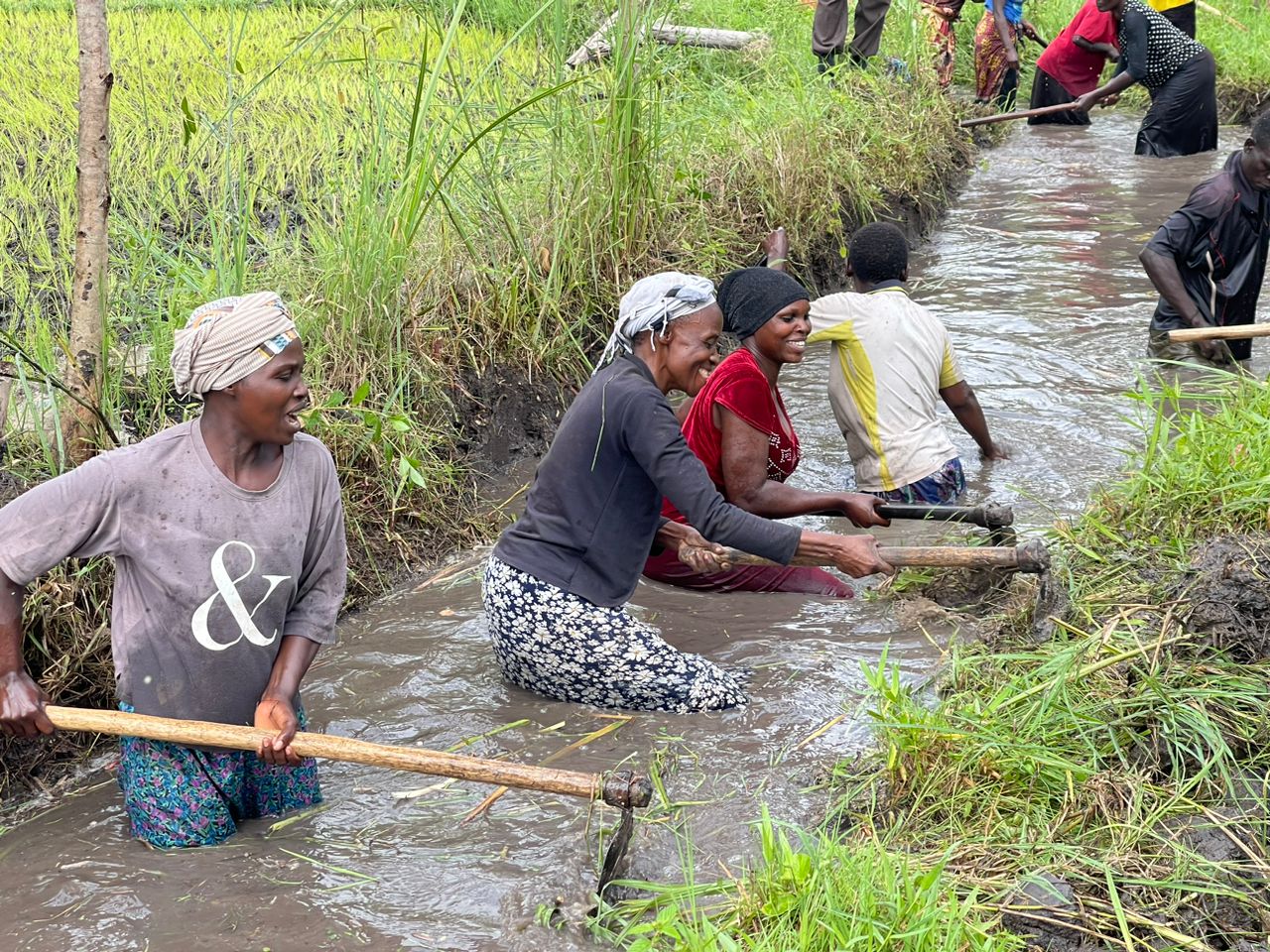
Ugandan Red Cross actions in November 2023 as part of its early action protocol for floods likely to have been exacerbated by El Niño included cleaning water sources and dredging channels (photo) and mapping evacuation routes. Red Cross Red Crescent societies across Africa faced opposite impacts from that ENSO phase. (Library photo: Uganda Red Cross via social media)