
Blog: Thinking about multiple hazards. Suggestions from a Nairobi workshop
By Dorothy Heinrich and Tesse de Boer, Climate Centre, Nairobi
Compound and cascading risks are not a future concern for the African region but a defining challenge for preparedness today. How can we meet this operational reality? The question dominated last month’s multi-risk innovation lab run by the IFRC, the Netherlands Red Cross and the Climate Centre, and hosted by the Kenyan Red Cross in Nairobi.
It brought together National Society staff from (alphabetically) Burkina Faso, Burundi, Chad, Ethiopia, Finland, Germany, Kenya, Mali, the Netherlands, Niger, Rwanda, Somalia, South Sudan, Uganda and Zambia, as well as observers from the UN Food and Agriculture Organization and the European Commission, for a high-energy week of discussion, testing concepts, and practical ideas.
National Societies across the region continuously respond to complex crises – a point made powerfully by Baba Moro Emmanuel Awasi, Disaster Risk Manager for the South Sudan Red Cross: “We have quite a number of risks: floods, droughts, heatwaves, epidemics like cholera, and armed conflict, and they are deeply interconnected.”
This innovation lab was part of a programme funded by the Netherlands Ministry of Foreign Affairs (Response Preparedness) helping National Societies anticipate and respond to disasters. The operational reality for many is that hazards rarely happen in isolation, yet many plans for humanitarian intervention focus on single events.
The chief objective of the workshop was to increase understanding of multi-risk concepts and analyses, and generate actionable ideas to connect Early Action Protocols and contingency plans to address them.
It built on work by, for example, the Anticipation Hub’s Multi-Risk Technical Working Group, which is jointly led by the Climate Centre, rethinking current practice with Anticipatory Action for and response to different risks.
Over four days we worked through key concepts and real-life operational challenges, and explored good practice in a highly interactive innovation-lab format.
The first day focused on key concepts and reflected on the difficulty of anticipating and responding to compound crises using the tools currently available to National Societies, including EAPs.
On the second day, we ran a fascinating “doctor-patient session” when National Societies presented a challenge they were currently facing and found operable solutions that represented an advance on current plans and protocols. We talked about techniques and developed tailored scenarios that we tested.
Mubita Nyambe of the Zambia Red Cross said: “Simulation exercises using Anticipatory Action plans help us see gaps – and that’s where real learning happens.”
‘We have quite a number of risks: floods, droughts, heatwaves, epidemics – especially cholera, and conflict, and they are all connected’
On the third and fourth days, we continued these reflections through the hands-on setting of solutions and innovations. This resulted in concrete next steps: “We are exploring joint cross-border contingency plans because we share the same challenges [with our neighbours],” said Wilson Nduwimana of the Burundi Red Cross.
“Contingency planning should not be separated from anticipatory action – there must be a link,” was the conclusion of Mubita Nyambe of the Zambia Red Cross Society.
We were challenged at the beginning of the workshop to create something that participants would remember, but our own main takeaway centred on the sheer number of opportunities to include Anticipatory Action in contingency planning for multiple risks.
“It’s important to move to true multi-risk thinking – especially understanding cascading and non-linear impacts,” said Paul Rutebuka of the Rwanda Red Cross.
Yvonne Rijna of Netherlands Red Cross adds: “Participating in the Nairobi workshop provided many invaluable insights from Red Cross colleagues in Africa, drawn from both their operational and planning experience.
“The workshop came at the perfect time: we can apply the insights immediately as my colleagues and I are working on the development of flood contingency plans for the Netherlands Red Cross.”
It’s now hoped participants will take different elements and ideas forward with their respective National Societies, so stay tuned for more on the various ideas that emerged from the workshop. There will also be virtual meetings with the Nairobi group for them to share updates, as well as follow-up events with the Anticipation Hub and at the East Africa dialogue platform.
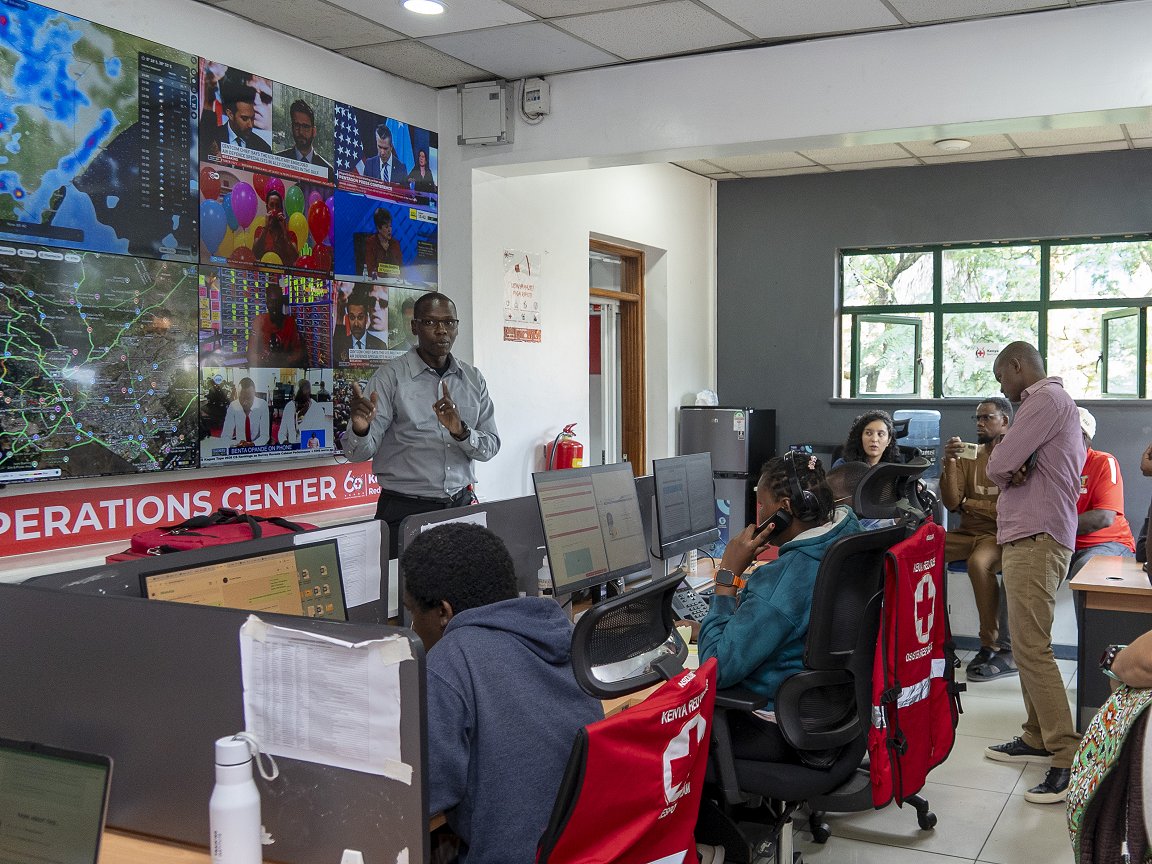
We were lucky during our stay in Nairobi to be able to visit the Kenya Red Cross’s impressive Emergency Operations Centre, pictured here, where we learned about its 24/7 service. (Photo: KRCS)