
Europe follows Asia into unseasonal – and in places record-breaking – extreme spring heat
By the Climate Centre
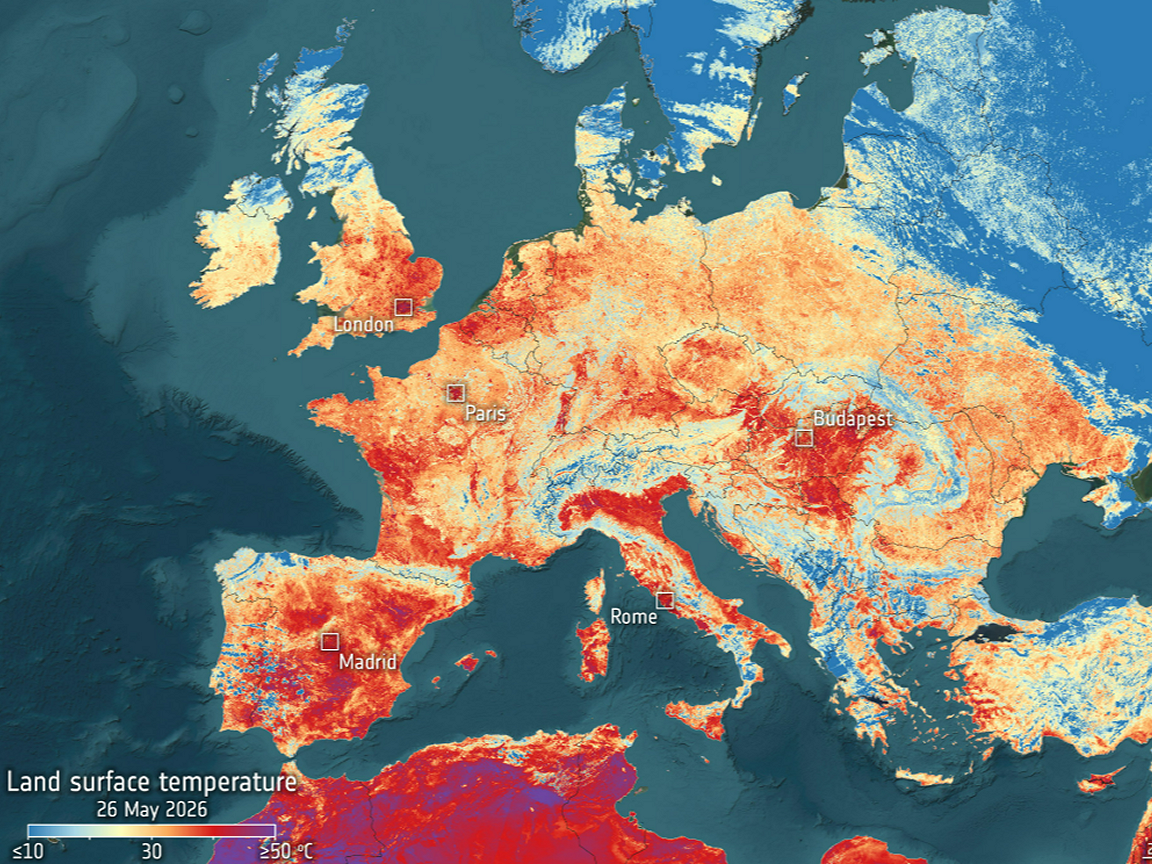
Satellite imagery published by the European Space Agency today (photo) revealed the extent of the unseasonally extreme heatwave affecting the world’s fastest-warming continent, “with record air temperatures for May in many countries making it feeling more like the height of summer, rather than late spring.”
The UK recorded an air temperature of 35ºC this week – a full 2ºC higher than the country’s previous high for May, while Ireland’s air temperature also rose more than a degree above its monthly record, the ESA said.
Such temperature record are more normally broken by fractions of one degree.
The Hungarian weather service said Monday that Budapest’s temperature record had reached a new high of 32.2ºC, and Germany, Italy, Spain and Switzerland also registered unseasonal heat.
Lifeguard rescues double in a year
The heatwave is reflected in this satellite image, which shows daytime land temperatures that can be considerably higher than the air, with rock and soil retaining heat.
As they do now regularly every year, National Societies in Europe have been quick off the mark to redistribute advice to the public on staying safe in the heat and the sun – including recommendations to swim only in lifeguarded locations inland or on the coast.
The BBC today reported nine water-related deaths in the heatwave in Britain, and TF1 quoted the French government as saying five people had drowned.
Beach lifeguard rescues in the UK – a role also undertaken by National Society volunteers in some countries – reportedly doubled last year.
Ashley Jones, Head of Water Safety and Education at Royal Life Saving Society UK, said: “As air temperatures rise, it’s important people don’t underestimate the risks associated with entering open water. Even during a heatwave, water will remain dangerously cold, and cold water shock is a very real danger.
“Sudden immersion can cause an involuntary gasp, rapid breathing and panic, which can quickly lead to a loss of control in the water, even for strong swimmers.”
‘Our bodies have not had time to acclimatise’
Garyfallos Konstantinoudis of Imperial College London said yesterday: “This exceptional spring heatwave is far more than an uncomfortable disruption to our sleep, work, or study. For vulnerable groups without access to cooling … these temperatures are quite simply dangerous, and potentially fatal.
“Early-season heatwaves are especially hazardous because our bodies have not had time to acclimatise.”
British Met Office scientists last year found the chance of surpassing the May temperature record of 32.8°C has increased with greenhouse gas emissions: it was three times more likely in the current climate than in one not impacted by human-induced climate change.
Europe’s spring heatwave closely follows unseasonal heat across Asia, with reported temperatures in China, India, Japan, Pakistan and South Korea climbing well above their long-term averages.
At the end of April, for example, The Times of India said the heatwave there had turned ten cities where the thermometer reached 46ºC into “scorching furnaces”.
The unseasonal global heat, which may now be peaking in Europe, comes a few days ahead of the 5th edition of Heat Action Day on 2 June that will gather communities to tackle the growing threat of extreme heat. This year’s theme – indoor heat – puts the spotlight on the health risks people face in their homes, schools, workplaces, and care facilities.
This image was captured by the Copernicus Sentinel-3 mission on 26 May. It shows multiple locations experiencing temperatures more typical of the Middle East and North Africa in summer than Europe in spring. (Credit: ESA)