
Europe wildfires: ‘Back-to-back heatwaves and early drought created a tinderbox’
By the Climate Centre
Climate change reinforced the extreme weather behind the devastating wildfires in France and Spain, World Weather Attribution scientists said today in a rapid study of the fires that have displaced hundreds of thousands of people and triggered an all-out response by National Societies and their governments.
“Human-induced climate change made the extreme fire-weather that fuelled the recent destructive wildfires at least twice as likely in France and at least 20 times more likely in Spain,” the study says.
It adds: “Some of the wildfires were so large that they created their own weather system, making it very difficult to contain the flames.”
Wet winters followed by dry springs are becoming a key driver of wildfire risk in the affected regions, contributing to the growth of vegetation which then dries out in spring and early summer providing fuel for fires.
“This is the pattern we are seeing more and more across Europe: heatwaves, drought and wildfires feeding into one another, and communities bearing the consequences,” IFRC Deputy Regional Director for Europe Maria Alcazar Castilla said in an IFRC news release this week.
“The Red Cross is responding to the immediate emergency, but we also need sustained investment in preparedness and climate adaptation, so communities are better able to withstand future shocks.”
Spanish Prime Minister Pedro Sanchez said Monday: “What we’re experiencing isn’t a succession of isolated events. It’s the most painful expression of a climate emergency that is making [extreme] Level 6 wildfires more ferocious, heatwaves more frequent, and our territory more vulnerable.”
The state of emergency in Spain has now been lifted and the fires threating Madrid were Friday reported to have stopped spreading.
‘Super-rapid protocol’
WWA has recently published analyses showing that both the June heatwaves and the drought still affecting Europe were fuelled by human-induced climate change.
In September 2025, the team also found that climate change had worsened last year’s wildfires in Spain and Portugal while a separate analysis looking at the 2025 fire season reached a similar conclusion.
Given the extensive evidence and the short timeline of the study, the WWA researchers used what they call “a super-rapid protocol”, concluding additionally that in today’s climate extreme wildfire episodes are expected to occur once every 20 years in south-west France and once every six years in central Spain.
IFRC Secretary General Jagan Chapagain said on social media yesterday: “As extreme heat, drought and wildfires become increasingly interconnected, investing in preparedness and climate adaptation has never been more important.
“My thoughts are with everyone affected by these devastating fires, as well as the volunteers and local responders providing vital support on the ground.
Climate Centre Director of Programmes Julie Arrighi added today: “What we’re seeing now in France and Spain goes well beyond what we would expect from past events. This study shows that, in just a few years, the risk of similar fire events has increased due to climate change.
“As the conditions that fuel severe wildfires, such as extreme heat and drought, become more frequent and intense, we must accelerate implementation of fire adaptation and prevention efforts while also deepening investments in fire response capacity.”
Emergency accommodation
The Spanish Red Cross responded to the fires around Madrid, Ávila, Toledo, and Castellón, mobilizing nearly 700 staff and nearly 30 ambulances; its 78 emergency shelters were hosting more than 4,400 people and providing food, water, health care and psychosocial support.
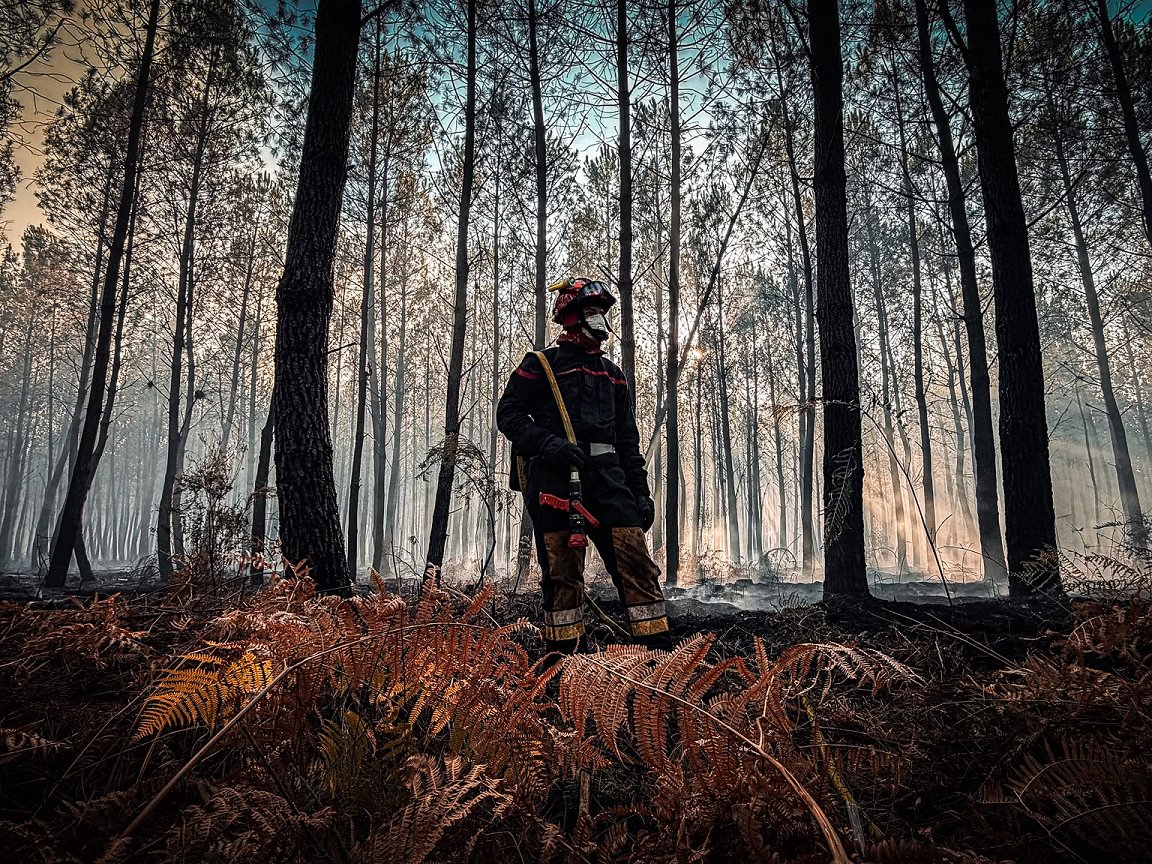
In Gironde and Landes, the French Red Cross has mobilized more than 300 volunteers from 60 local branches: teams are supported evacuations and set up emergency accommodation with beds, hygiene kits, masks, camp beds and blankets; the National Society was also preparing to assist people with rebuilding their daily lives once the fires are brought fully under control.
In the latest wildfire emergency in Europe, some 8,000 people were temporarily evacuated in the on the Greek island of Crete as fires stoked by strong winds threatened villages and tourist resorts.
Hellenic Red Cross volunteers were on the front line of the response “from the very first moment”, the National Society said on social media yesterday.
Two firefighters died on Crete Wednesday tackling a fire near Krya Vrysi town in the Rethymno region; a third firefighter died on the Greek mainland, the BBC reported.
A French firefighter stands amid what’s left of a burnt forest in western France, one of a team using a controlled burn to create a fire-break that wildfires cannot jump. (Photo: Pompiers de France via social media)