
Colombian Red Cross combines science and anticipation in response to El Niño
By the IFRC
(This story appeared first on the IFRC website last week. It has been edited slightly here for length.)
Through an Early Action Protocol funded by the IFRC, the Colombian Red Cross is implementing anticipatory measures in the departments of Tolima and Cesar before drought reaches its critical point.
As El Niño intensifies in the region, forecasts confirm that the time to act is now, before its effects impact the well-being of the population. History and science show that this phenomenon typically brings prolonged droughts, severe water shortages and wildfires to Colombia.
The current climate crisis, exacerbated by pre-existing vulnerabilities, requires humanitarian efforts to invest in advance preparedness. In light of this situation, the Colombian government has declared a state of disaster in order to mobilize resources and coordinate the country’s preparedness efforts.
This is precisely the approach adopted by the Colombian Red Cross and the IFRC when we approved the EAP for drought in late 2024; it was activated in June 2026 at the first signs of drought.
But what does preparedness look like beyond satellite models? It translates into concrete human responses. Examples include a farmer saving their vegetables by adding water-retention agents to the soil, a rancher giving their animals nutritional supplements before the pastures dry up, and a family getting clean water at home before the local water supply runs out.
Funded through the anticipatory action pillar of the IFRC Disaster Response Emergency Fund, this protocol is a simplified and agile model specifically designed to release financial resources in response to crises that have not yet occurred but whose impacts are highly predictable.
It enables local Red Cross teams to translate complex weather forecasts into operational decisions that mitigate the impact of dry seasons or droughts on vulnerable communities.
Water-retention agents for the soil, nutritional supplements for animals before pastures dry up, clean water at home for families
The EAP operates based on two triggers. The first measures precipitation deficits and the second measures rising temperatures. These are measured using official data generated by the Institute of Hydrology, Meteorology and Environmental Studies.
In Colombia, the precipitation forecast indicates a probability of over 50 per cent that rainfall will be below normal from June to August.
“This deficit in precipitation leads to water stress and reduced access to water,” explained Marinson Buitrago Salinas, Head of Disaster Response and Emergency Operations Management at the Colombian Red Cross.
“This would affect production, agriculture, livestock, and communities’ access to water through aqueduct systems or the community-based systems they use to obtain water.”
By cross-referencing climate data with population density and agricultural and livestock activity, a technical analysis determined that the departments of Tolima, in the centre of the country, and Cesar, on the northern Caribbean coast, are the areas of greatest exposure and vulnerability.
Early intervention provides people with practical tools they need to cope with the impact of climate change and avoid socioeconomic collapse. For farming families and smallholders, the loss of a single harvest or the death of livestock can lead directly to food insecurity and forced displacement.
For this reason, the EAP focuses its efforts on 2,400 people in Tolima and Cesar, prioritizing small farming families, female-headed households, and communities with limited access to basic services and social protection.
In Tolima, interventions are designed to preserve rural livelihoods. One such action is the distribution of water-retention elements to 600 people. This product is incorporated directly into the soil to optimize water retention around plant roots, enabling crops to survive for extended periods with a fraction of the usual amount of irrigation. Nutritional blocks are also being distributed to livestock to prevent them from dying due to a lack of dry pasture.
At the same time, the cash transfer programme for those without bank accounts aims to support 900 people. Through pre-established financial agreements, this mechanism enables families to quickly access funds by simply presenting their ID. This gives them the autonomy to purchase food, medicine and agricultural supplies from local businesses before the drought pushes up the prices of basic goods.
‘Our support must be tailored to each country, each risk, each community and each phase of the emergency’
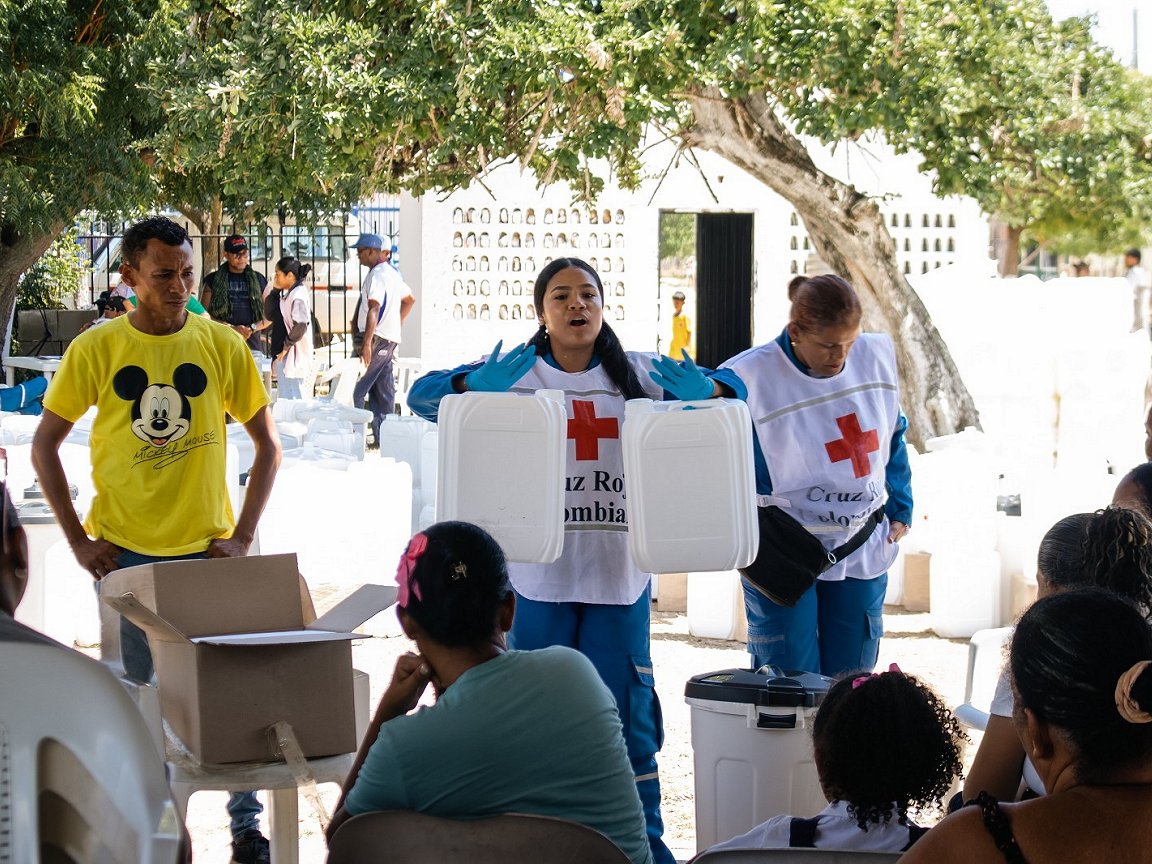
Furthermore, in areas where water shortages directly threaten human health, particularly in the Cesar department, the water, sanitation and hygiene initiative aims to provide 900 people with a supply of clean water.
As well as distributing family kits containing buckets, drums or jerry cans, and household water purification filters, the initiative involves setting up and operating a community water treatment plant with the capacity to treat up to 30,000 litres of water per day.
This initiative establishes the Colombian Red Cross as a pioneer within the country’s National Disaster Risk Management System, as it is the only entity to have a fully implemented Early Action Protocol in the field.
Coordinated efforts between the Colombian Red Cross, the IFRC and local stakeholders have demonstrated the feasibility of anticipating impact through prior institutional strengthening.
Prior to the confirmation of climate triggers related to El Niño in Tolima and Cesar, the Red Cross trained its technical teams and volunteers in 18 branches nationwide, pre-positioned supplies and secured contracts with financial service providers. This ensured the capacity for immediate deployment as soon as scientific data issued a warning.
“Some countries face both droughts and excessive rainfall in different parts of their territory. Colombia is a clear example of this complexity,” said María Martha Tuna, IFRC Manager of Operations, Evolving Crises and Disasters for the Americas.
While El Niño triggers severe droughts in the Andean and Caribbean regions of Colombia, it can also cause an unusual increase in rainfall and flooding in the south of the country.
“This means we cannot develop a single, one-size-fits-all package for the entire region. Our support must be tailored to each country, each risk, each community and each phase of the emergency. That is why this plan pays special attention to people whose livelihoods and access to essential services depend directly on weather conditions,” María Martha added.
Colombia’s experience is part of a regional plan coordinated by the IFRC to address the increasingly intense and frequent El Niño phenomenon in the Americas. By combining scientific knowledge with grassroots community work, the IFRC and the Colombian Red Cross demonstrate that we can use forecasts to design and implement real solutions that protect the lives of the most vulnerable populations before a disaster strikes.
As part of an Early Action Protocol for drought, the Colombian Red Cross has distributed 100 kits for the treatment and storage of safe water to families in the village of El Carmen, in the municipality of El Paso, Cesar. (Photo: Colombian Red Cross)