
Summer ’26 rewrites meteorological history in Europe
By the Climate Centre
Western Europe has just had its warmest June–July period on record, the European Commission’s Copernicus Climate Change Service said this week.
Much of western Europe and large parts of central and eastern Europe also saw drier-than-average conditions, mainly associated with extreme temperatures and exceptional wildfires, Copernicus added. River flows were “much below average to extremely low … with impacts on multiple sectors.”
Just over 70 per cent of England is now in official drought, the UK Environment Agency announced on Monday, for example, along with all of Wales, leaving nearly 30 million people facing restrictions on their use of water.
This summer is on course to be the UK’s hottest overall since records began, the Met Office, said yesterday, replacing 1976 in folklore as the iconic summer to end all summers.
Provisional Met Office data shows that the UK’s 1 June–10 August average now stands at 16.48°C, or 1.88°C above the 1991–2020 average.
This year is the first when 35°C or above has been reached in three separate calendar months – May, June and July – with August on course to be a fourth. “In the late 20th century, it was very rare for temperatures in any year to reach 35°C even once,” the Met Office said.
Extremely high temperatures of over 35°C were also forecast to continue for France, Spain and Italy this week, with the latest heatwave extending to south-east Europe, including in Albania, Croatia and Greece, as well as northern areas including Germany and Poland.
For the third time this summer the Polish authorities last week invoked emergency measures to ensure electricity supply, faced with rising demand for air conditioning and refrigeration; it had only done so twice in the eight years since the powers were introduced.
At the end of June 40.5°C was recorded in the town of Słubice, Poland’s met agency said, breaking the previous record of 40.2°C.
‘In the late 20th century, it was very rare for temperatures in any year to reach 35°C,
even once’
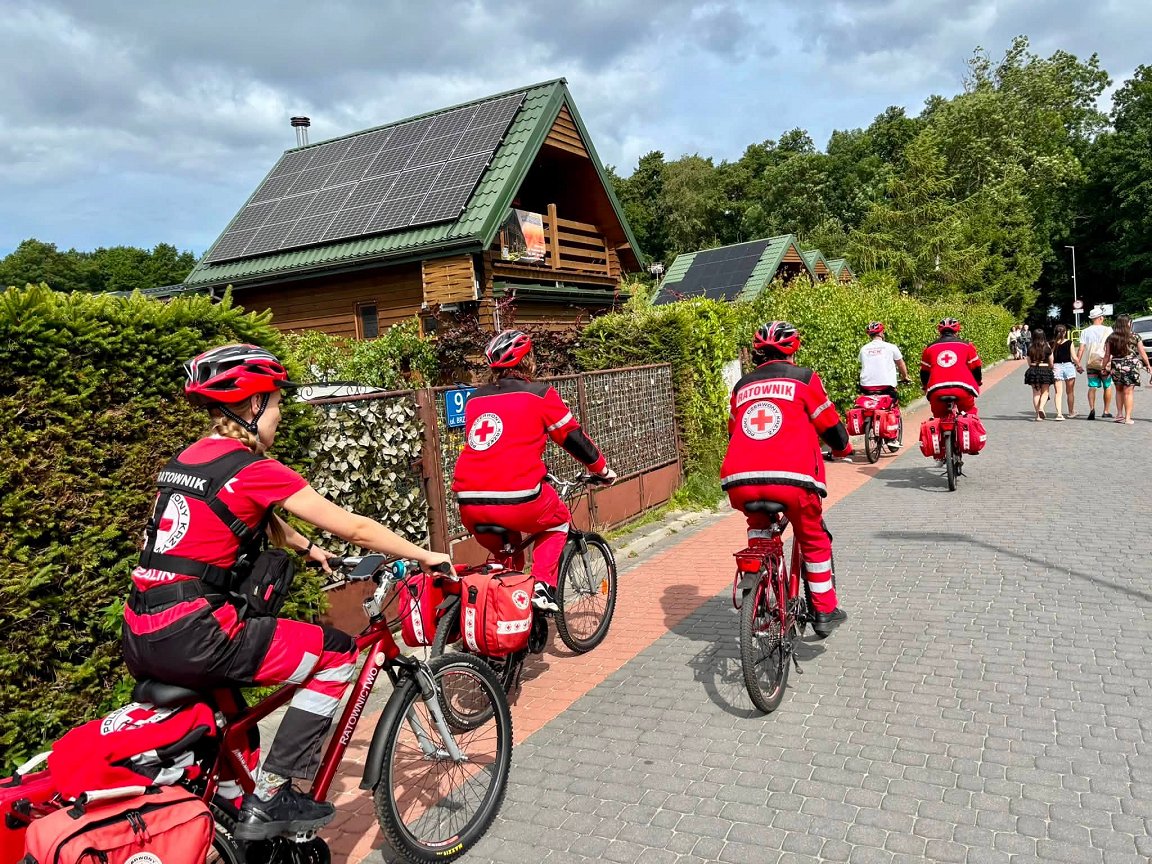
In Szczecin the Polish Red Cross has deployed bicycle patrols along the Baltic coast, responding to a rise in heat-related illness, injuries and other medical events as visitor numbers surge, the IFRC reported. They provide first aid and medical support on beaches and coastal areas, where vehicular emergency response can be delayed by crowds and limited roads.
“No matter what comparator we use, the present looks different from even the recent past in the world’s fastest-warming continent,” said Roop Singh today, who leads on heat preparedness at the Climate Centre.
“Extreme heat in European countries that are totally unused to it throws up additional challenges for National Societies and the humanitarian sector.
“This summer has been another reminder of the how severely the climate is shifting in Europe, and reminds people of the urgency to adapt our cities, workplaces, and homes to the new reality, as well as the difficult idea that summer is not all fun.”
The Climate Centre is next month joining a new project supported by the European Commission called EUROASIS, or EUROpean Adaptive, Systemic and Inclusive Solutions, to promote heat resilience in heat-prone cities and regions.
It bring together 29 partners from four pilot cities: Amsterdam, Athens, Reggio Emilia and Zaragoza, and seven regions that will “test and adopt what works”.
The goal will be to turn target areas into “cool, safe, inclusive oases, through nature-based cooling, better urban design, smart early warning systems” and long-term financing, organizers said.
Polish Red Cross cycle patrols along the Baltic coast operate in coordination with the West Pomeranian Voluntary Water Rescue Service and emergency medical services from the local ambulance station. (Photo: Polish Red Cross via IFRC)