
Study: Climate change and El Niño combine to intensify Indonesian fire weather
By the Climate Centre
The current strong El Niño amplified by human-induced warming drove severe, widespread fire weather across Indonesia’s peatlands and forests between August and October 2026, according to new research by World Weather Attribution published last Thursday.
The conditions added fuel to a fire season that has seen over a million acres burned in Kalimantan, the Indonesian part of Borneo, and the island of Sumatra. The fires have generated toxic smoke that exposed millions across South-East Asia to poor air quality.
Scientists from Indonesia, the Netherlands, Sweden, the UK and the US found that El Niño was the primary cause of the severe lack of rainfall while climate change was the primary driver behind high seasonal temperatures.
They also noted that parts of Indonesia have seen extensive land-use changes in recent years – including deforestation often associated with burning and the draining of peatland – which has increased the susceptibility of landscapes to fire during prolonged hot, dry conditions.
Indonesia’s Health Ministry reported more than 400,000 respiratory infections linked to the fires by the beginning of this month, including about 180,000 children under nine; smog also had serious impacts in Malaysia, the Philippines, and Singapore.
‘Wells, springs and small reservoirs
have declined or dried up’
Pramudhian Firdaus, a meteorologist Melbourne University who also works with with the Indonesian Agency for Meteorology, Climatology and Geophysics, said: “Indonesia’s landscapes have changed dramatically over the last 30 years, with extensive peatland drainage and deforestation creating landscapes that can be extremely vulnerable to ignition.
“El Niño years are strongly linked to bad fire seasons here, and these findings show how fossil fuel emissions are throwing further fuel on the fire.
“The toxic haze affected millions of people across South-East Asia, driving up respiratory illnesses and impacting people’s quality of life. These findings show how both emissions reductions and sustained forest and peatland protection are important in reducing future risk.”
The NASA Earth Observatory noted in September that fires in tropical peatlands are slow-burning, highly polluting, and notoriously difficult to extinguish because they smoulder at low temperatures underground. By one estimate it cited, peat fires generate three times more fine particulate matter than other tropical forest fires, five times more sulphur dioxide, three times more organic carbon, and two times more methane and carbon monoxide.
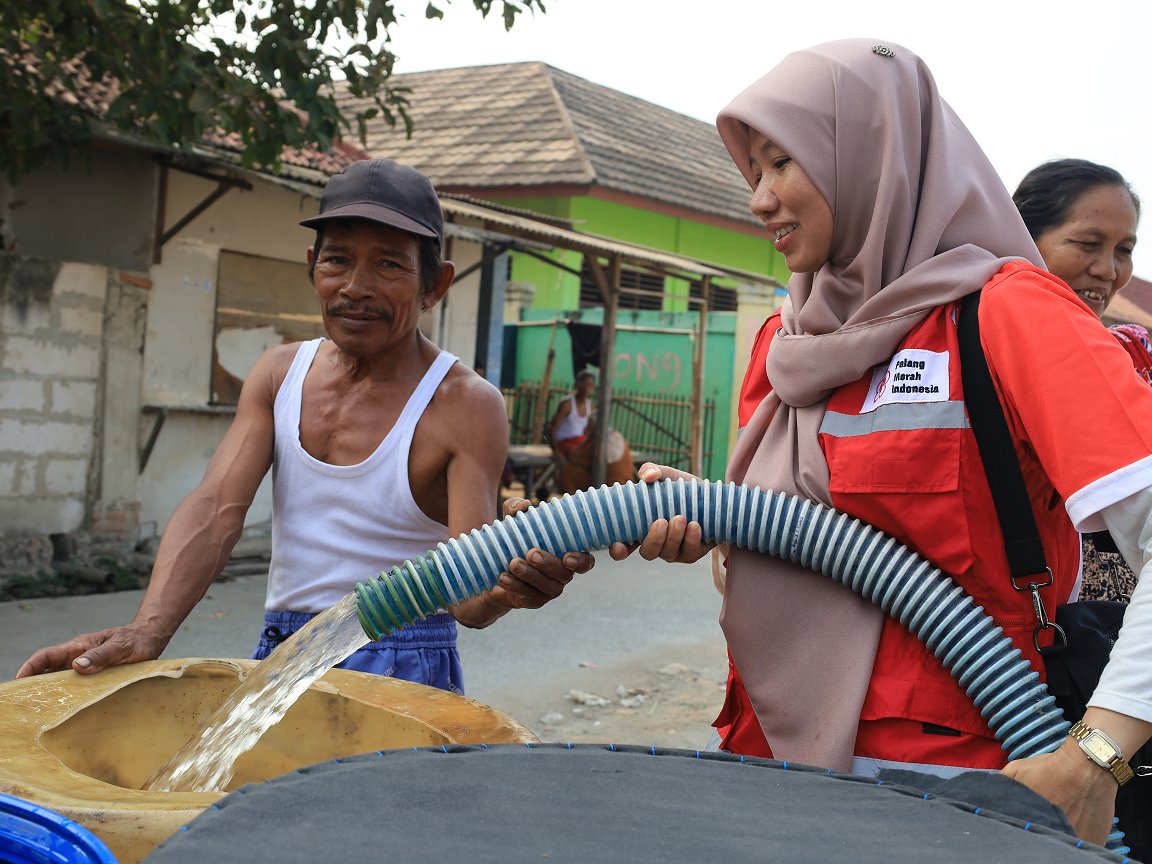
The Indonesian Red Cross (PMI) has reported that “prolonged rainfall deficits” reduced the availability of water for households Java, Bali, Nusa Tenggara, Sumatra, Kalimantan and Sulawesi. “Wells, springs and small reservoirs have declined or dried up, leaving communities increasingly dependent on emergency water assistance,” the PMI said.
A grant of nearly 500,000 Swiss francs from IFRC-DREF in September helped the National Society expand its drought operation to reach up to 200,000 people, and the International Federation also sent WASH specialists to strengthen planning and water quality.
Since June, the PMI has been delivering emergency water relief using its local branch networks and water tankers, like here in Tangerang village, Banten province. (Photo: PMI via IFRC)