
Herders adapt to a changing climate in Mongolia’s Gobi Desert
By Kexuan Tong, IFRC Communications Officer
(This story appeared first earlier today on the IFRC website.)
In Mongolia’s arid south, water is becoming scarcer and extreme weather increasingly difficult to navigate. For one herder family, adapting to a changing climate is about protecting both their livestock and a way of life they hope to pass on.
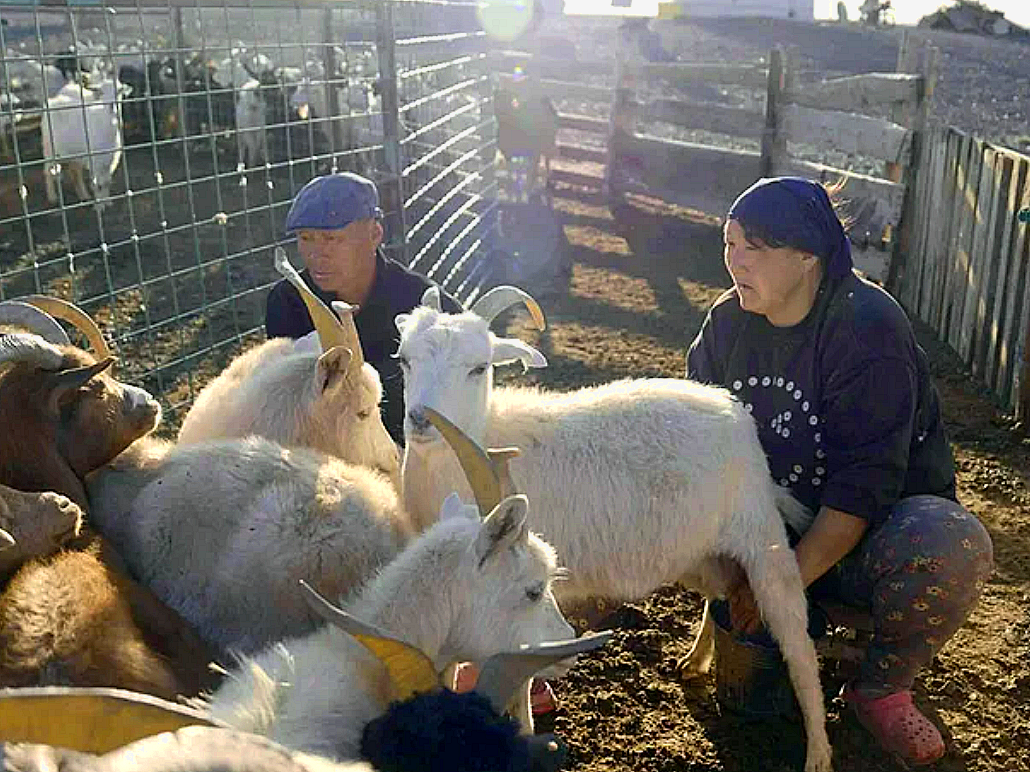
Before sunrise in Mongolia’s southern Gobi, Oyungerel, 48, and her husband, Munkhchuluun, 55, are already at work. Their goats will soon leave to graze, so the morning’s milking begins early. Fresh milk is carried into one of the family’s two gers, traditional Mongolian tent-like dwellings, where Oyungerel heats and strains the milk to make traditional dairy products.
Outside, the landscape stretches towards the horizon. Sparse vegetation breaks up the rocky terrain, and no other herder household is visible for kilometres.
For generations, Oyungerel’s family has lived and worked on this land in Noyon district, Umnugovi province. But as droughts become longer and water increasingly scarce, life in Mongolia’s arid south is becoming harder to sustain. Still, leaving for good was never an option.
Oyungerel recalls five years of severe drought between 2018 and 2023. With little rain and insufficient pasture, herder families across Noyon had to move elsewhere in search of grazing land for their animals.
‘All four seasons’
But relocation brought new challenges. As herders arrived in neighbouring districts, already fragile grazing areas came under additional pressure, creating uncertainty for both host communities and newly arrived families.
“Migrating into another land presents quite a few difficulties for us herders – financially, mentally and emotionally,” Oyungerel says.
When conditions improved in 2023, her family returned to Noyon. Today, she and Munkhchuluun raise about 280 livestock. They have two children. Their older son plans to return to herding with the family after the birth of his own child, while the younger child is in boarding school.
“Since our livelihood depends on herding through all four seasons, we try our best not to lose our livestock and move to the town centre, where we wouldn’t know what to do,” she says. “Instead, we choose to remain here, herd our livestock, and continue to endure and survive.”
Constant relocation in search of pasture is not a lasting solution. As droughts lengthen, the question for families like Oyungerel’s is how to adapt on their own land.
Water scarcity caused by climate change remains one of the family’s most pressing challenges. Oyungerel says water levels and quality in local wells have deteriorated, while natural water sources that livestock once relied on have vanished altogether.
“There used to be an open spring near us where the livestock could drink well, but now there is nothing left. It has completely dried up,” she says. Standing beside the family’s water system, Munkhchuluun points to the pump and storage tank that now help sustain their herd.
Livestock shelters
Helping families like Oyungerel’s cope with these pressures is a focus of the Supporting Climate Change Adaptation in Mongolia project, implemented by the Mongolian Red Cross Society (MRCS).
The two-year project, which is still underway, is supported by the IFRC and funded by China’s Global Development and South-South Cooperation Fund. It aims to support herder communities in four provinces: Umnugovi, Govi-Altai, Bayankhongor and Dundgovi.
In August 2026, the MRCS organized community meetings to give families a chance to discuss their needs, priorities and role in the activities planned for the months ahead, including the construction of livestock shelters, the provision of agricultural tools and equipment, and support to diversify livelihoods.
Some of that work is already moving. Together with pasture-management specialists, the MRCS has trained herders in sustainable grazing, livestock care and preparing supplementary feed.
It is also supplying materials and construction guidance so that herder groups can build livestock shelters before winter conditions arrive.
Water and emergency readiness are part of the project too. To ensure access to safe water, sanitation and hygiene in communities, particularly in disaster-prone and vulnerable areas, the MRCS organized training for 280 community members and conducted additional training on water-resource monitoring. It has also procured hygiene kits, blankets and mattresses to pre-position for use in emergencies.
In Umnugovi, plans are underway to establish new water harvesting facilities to help address the severe water scarcity faced by herder communities.
As weather patterns become less predictable, access to timely information can make a critical difference. Through the project, Oyungerel has attended climate change and early warning training designed to help herder communities anticipate and respond to climate-related risks.
Herders receive weather warnings through SMS messages, television and social media. But traditional knowledge remains an important source of information. The forecasts are combined with knowledge passed down through generations.
“We observe the weather conditions ourselves – watching the sky and our livestock’s behaviour – and communicate via the phone network, telling each other if rain is coming or if the weather is turning bad,” Oyungerel says.
‘Nomadic culture’
By combining modern forecasting systems with generations of local knowledge, communities are strengthening their ability to prepare for and respond to increasingly extreme weather.
For Oyungerel, adapting to a changing climate ultimately means being able to continue the life her family knows. “Our goal is to adapt to and overcome climate change as much as possible, stay in our native land, and pass down this nomadic culture and tradition to future generations,” she says.
That commitment to the next generation extends to schools. MRCS youth teams and trained youth volunteers are working with eight schools to engage more students in climate awareness and disaster preparedness. Humanitarian rooms were set up at the schools in April 2026, giving children and young people a place to take part in humanitarian activities, training and awareness-raising initiatives.
As Mongolia’s herders face the growing impacts of climate change, families like Oyungerel’s are finding ways to adapt while holding on to the traditions, knowledge and livelihoods that have shaped life on the steppe for centuries.
Beyond Mongolia, the IFRC network supports communities on the front lines of the climate crisis, combining early warning, preparedness and locally led action to reduce the humanitarian impact of extreme weather. Through its Global Climate Resilience Platform, the IFRC network aims to support 500 million people facing the effects of climate change.
Oyungerel and Munkhchuluun milk their goats at dawn at their herding camp in Mongolia’s southern Gobi. (Photo: Dash-Ochir Sukhbaatar/MRCS)