
‘The climate crisis is one of our most fundamental responsibilities’
By the Climate Centre
The Chief Executive of the British Red Cross, Beatrice Butsana-Sita, has told an audience in London that “the climate crisis is one of our most fundamental responsibilities”.
She was speaking yesterday to specialists and experts from at least 70 different organizations gathered in the historic Crypt on the Green venue, Clerkenwell, for the full rolling out of the Climate Centre’s Strategy 2030, which was published online Monday.
The event was hosted by the BRC and the IFRC, whose climate lead Ninni Ikkala Nyman also briefed the group on the climate-related components of the IFRC Global Plan for 2026, which describes climate change as “a global humanitarian emergency, amplifying the intensity of extreme weather events, increasing unpredictability and worsening existing vulnerabilities.”
It was organized and coordinated by the BRC’s Head of Climate Resilience, Erica Mason.
Against a backdrop of rising risk and shrinking finance, participants also heard from Gerard Howe, head of the UK Foreign Commonwealth and Development Office’s Department for Adaptation, Nature, and Resilience, that “it’s difficult to overstate” how much the world has changed; until last year also Howe chaired of the Climate Risk and Early Warning Systems initiative.
The National Societies of Denmark, Finland, Germany, Norway, Sweden and the US were also represented.
Climate Centre Director Aditya Bahadur said he had taken on the role relatively recently, but had been aware of the centre and its work through his career, especially in the area of innovation: It was probably the only agency of its kind to have a cartoonist and an artist on the payroll, whose work helped get difficult messages across to a broader audience.
“One of the key functions of the Climate Centre is to build a global community of practice that is working together to address the most critical challenges of our time,” he said.
The Climate Centre strategy maps out a comprehensive vision for change, broken down into three key areas – creative solutions, collective action and capable institutions – along its traditional pathways of science, policy and practice, as well as specific enablers that now include AI.
‘One of the key functions of the Climate Centre
is to build a global community of practice’
“We must transform our relationship with this planet,” Ms. Butsana-Sita added, “strengthening resilience in communities and systems – including nature itself – so that people are better equipped to withstand the storms ahead.”
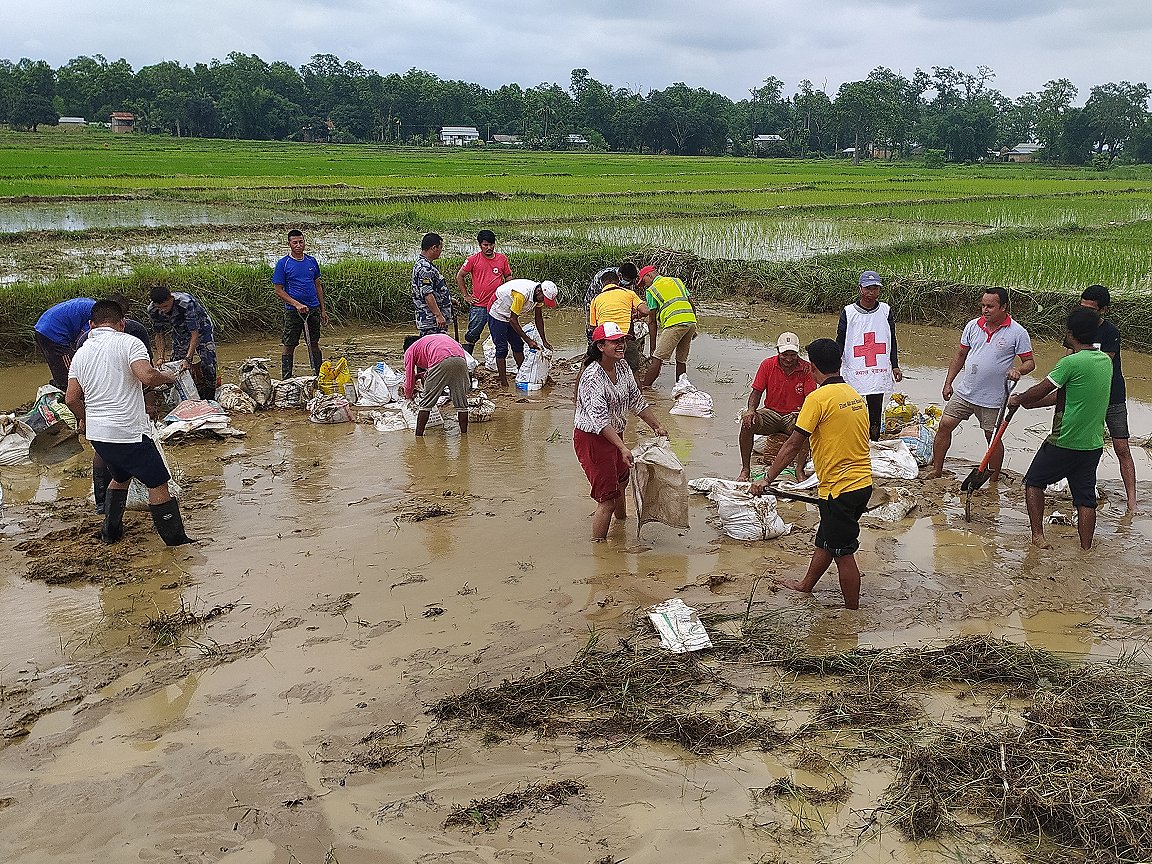
She cited a BRC-supported Nepal Red Cross project in which, working in partnership with the National Trust for Nature Conservation, the National Society is working closely with communities to address risk through nature-based solutions.
These include riverbed farming, bioengineering, agroforestry and lake restoration – work that was “helping to protect critical ecosystems and endangered species, such as the Indian pangolin and river dolphins, showing that climate resilience and biodiversity protection can, and must, go hand in hand.”
Nepal was one of 11 countries featured as hosting successful “stories of change” by the rest of the Climate Centre team at the Crypt on the Green event: Dorothy Heinrich (Technical Adviser), Megan Bailey (Head of Social Protection and Health), Liz Stephens (Science Lead), and Tilly Alcayna (Senior Technical Advisor, Health & Climate Change).
The Climate Centre provided technical support last year for a comprehensive heat action plan for the Nepalese city of Dhangadhi that suffers relentless yearly heatwaves of more than 40°C because of its low elevation aggravated by rapid urbanization and lack of green spaces; that work was also supported by the British Red Cross, and heatwaves in Nepal provided a theme for the cover of the new strategy.
The Climate Centre team presented other encouraging case studies from Bangladesh, Burkina Faso, Democratic Republic of Congo, Jamaica, Madagascar, Malawi, Mali, Somalia and South Sudan.
Nepal Red Cross volunteers and local people teamed up in Kishi province to reinforce defensive embankments after the River Triyuga broke its banks and flooded their village. Nepal’s rivers – their beds and their banks – are at the centre of a British Red Cross-supported project to address risk through nature-based solutions. (File photo: Nepal Red Cross via IFRC)