WMO: European heatwaves range ‘from the Arctic to the Mediterranean’
By the Climate Centre
Rapid warming in Europe – faster than any other continent – is reducing snow and ice cover while dangerously high temperatures, drought, and heatwaves are affecting regions from the Arctic to the Mediterranean, the WMO said yesterday in its latest European State of the Climate 2025 report.
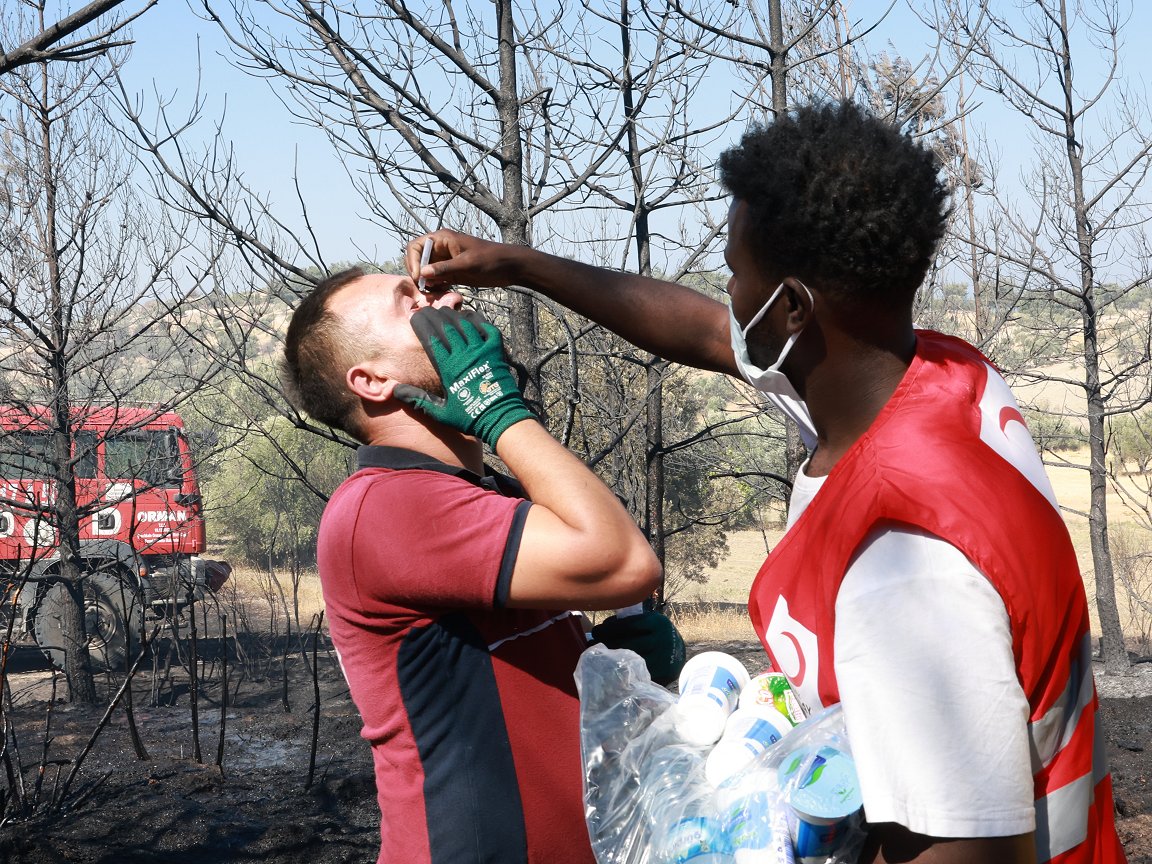
The report finds that almost all of Europe (95 per cent) experienced above-average temperatures last year, with wildfires burning just over a million hectares – the largest area on record (pictured).
Temperatures close to or actually inside the Arctic Circle exceeded 30°C while Fennoscandia saw a record three-week heatwave.
Glaciers in all European regions lost mass, with Iceland recording its second-largest such loss on record, and general snow cover was just over 30 per cent below average.
Sea temperatures for the European region were the highest on record, and 86 per cent of the region experienced strong marine heatwaves.
River flows were generally below average, however, and extreme rainfall and flooding were less widespread than recently.
WMO Secretary-General Celeste Saulo said yesterday: “The WMO State of the Climate has revealed the imbalance of energy on our planet, and the European State of the Climate produced jointly by WMO and [the European Centre for Medium-Range Weather Forecasts] reflects the impacts for Europe.
“Our joint effort to produce the ESOTC reflects how climate change is impacting biodiversity and the bold initiatives taken by European policy makers to protect and restore it.” Renewables supplied nearly half of Europe’s electricity in 2025, with solar power reaching a new contribution record of 12.5 per cent, the new report adds.
‘The burnt areas of Europe equated to an area larger than the whole of Cyprus’
Samantha Burgess, Strategic Lead for Climate at ECMWF, said the report painted “a stark picture: the pace of climate change demands more urgent action. With rising temperatures, and widespread wildfires and drought, the evidence is unequivocal; climate change is not a future threat, it is our present reality.”
The burnt areas of Europe equated to an area larger than the whole of Cyprus; Spain was particularly severely impacted alongside Cyprus itself, the UK, the Netherlands and Germany all seeing their worst wildfires on record.
The European Commission has identified rising wildfire risk as a key priority, the WMO says, with the IPCC’s sixth assessment of the global climate predicting an increase in fires across Europe.
Mauro Facchini, Head of Copernicus Unit at the European Commission, said: “The European State of the Climate 2025 report demonstrates once more the value of our joint efforts to have a world-class European Earth observation system.
“Maintaining our own state-of-the-art, reliable data records of our Earth system is vital for making informed policy decisions in our rapidly changing climate.”
Climate Centre Europe focal point Fleur Monasso writes: The growing climate emergency felt across Europe has generated a powerful Red Cross Red Crescent response in recent years.
National Societies are working together through an ambitious Climate Action Road Map while EU‑backed initiatives such as the Pathways2Resilience programme enable local collaboration in planning for transformational adaptation in cities and regions.
Above all, local climate action offers the key to success in these initiatives.
The Turkish Red Crescent deployed specialized staff, volunteers and mobile catering units alongside national efforts to defeat blazes that, at the end of July 2025, had reportedly claimed the lives of ten forestry and rescue workers from the AKUT Search and Rescue Association in central Eskisehir province. Against a backdrop of 40°C and above, fires were burning there and in Sakarya, Bilecik, İzmir, Karabuk and Manisa provinces. (Photo: Turkish Red Crescent via IFRC)