
Climate scientists see future of ‘supercharged monsoon rainfall’ for Asia
By the Climate Centre
World Weather Attribution scientists today published the results of a rapid study of Cyclones Ditwah and Senyar, reporting that associated extreme rainfall is being “supercharged” in the region, with observations showing a substantial increasing trend in heavy rain over recent decades.
But they add that “rapid urbanization and widespread deforestation contributed to turning the extreme rains into a disastrous event”, while natural climate patterns such as La Niña and the Indian Ocean Dipole also contributed to the rainfall, and they did not estimate the precise role of climate change.
In Sri Lanka, more than 350mm of rain fell in 24 hours, triggering widespread flooding and landslides across the country and affecting nearly 1.5 million people, according to the IFRC, which has now launched a 5m Swiss franc emergency appeal for the Sri Lanka Red Cross Society, in addition to a 1m CHF IFRC-DREF grant.
The IFRC’s Disaster Response Emergency Fund also this week released 1m CHF to help nearly 60,000 people in Indonesia’s Aceh and North and West Sumatra provinces.
‘Massive disruption’
The Sri Lankan authorities Tuesday put deaths at 638 with nearly 200 people still missing and tens of thousands in safety centres.
“The scale of this disaster is immense,” said John Entwistle, IFRC Head of Country Cluster Delegation for South Asia, speaking from Sri Lanka last week.
“While floodwaters are receding in some areas, humanitarian needs remain critical. People have lost loved ones and homes, and urgently need food, water, shelter, and medical assistance. Over 1.5 million people face food insecurity due to crop losses, disrupted livelihoods, and rising prices.”
‘A month’s rainfall in a day’
Lalith Rajapakse, a professor in the Department of Civil Engineering at the University of Moratuwa in Sri Lanka who took part in the WWA study, said today: “Cyclones like Ditwah have become an alarming new reality for Sri Lanka and the wider South and South-East Asian region, bringing unprecedented rainfall, widespread loss of life, massive disruption to economic activities, and unrecoverable damage to the environment.
Economic losses in Sri Lanka have been estimated at between 6 and 7 billion US dollars, he added, or as much as 5 per cent of GDP. “This should be an unequivocal eye-opener to the scale of future climate-driven extremes the country and the region must prepare for.”
Reading University research scientist Akshay Deoras said last week: “Climate change is rewriting the Asian monsoon. Rain now arrives in sharper bursts, dry spells stretch further, and downpours hit with greater ferocity.
“What was once a steady heartbeat for communities has become an erratic pulse, capable of unleashing a month’s rainfall in just one day.”
A Reading University study centred on South Asia and published a few days before the two cyclones struck examined four different climate scenarios for the Asian monsoon: all agreed that “wetter, more frequent storms will reach areas that rarely see them today,” with average rainfall from each storm increasing by approximately 10 per cent if the global average temperature reaches 2°C.
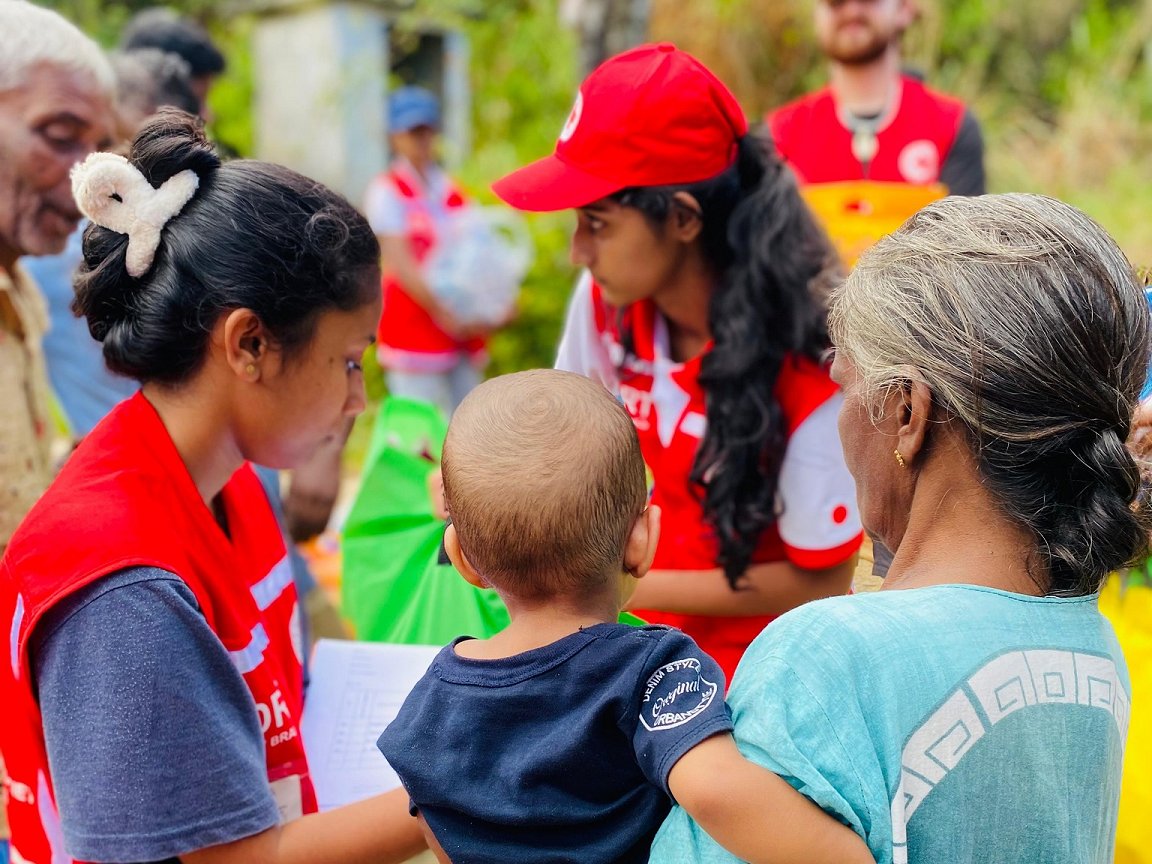
The Kandy district Sri Lanka Red Cross assisting the most vulnerable families affected by Cyclone Ditwah this week. Volunteers provided dry rations, sanitary supplies, drinking water, and other essential items. (Photo: SLRC via social media)