Red Cross Red Crescent 2026 climate summit promotes ‘move from discussion to action’
By the Climate Centre
The 2026 Climate Action Summit, hosted online today by the IFRC and the Climate Centre, brought together global leaders, Red Cross Red Crescent staff and volunteers, and community voices “to move beyond discussion and focus on action”.
Launching the day-long summit this morning, Climate Centre Director Aditya Bahadur said: “Communities around the world are already facing more frequent, intense, and unpredictable climate shocks and stresses, with humanitarian needs rising faster than ever before.
“The humanitarian sector has a critical leadership role to play, not only in responding to crises but also in supporting people to anticipate, adapt and build resilience before, during and after climate hazards.
“The urgency is clear and so is the opportunity. Together, we can accelerate locally led action that protects lives, livelihoods, and dignity at scale. That is why we have organized this Climate Action Summit.”
The summit was organized around four main themes: helping communities anticipate, prepare for and reduce climate risks; turning local leadership into action at scale; unlocking funding that reaches the communities who need it most; and new approaches to help communities anticipate and build resilience.
The full agenda encompassed 19 workshop topics and included sessions in Arabic on fragile and conflict-affected states, in French on “unheard voices from communities”, and in Spanish on climate-smart livelihoods and ecosystem management and restoration. Participants from all over the world could also choose from AI-generated subtitles in 30 languages.
Nearly 4,000 people registered to take part while 150 speakers from 30 National Societies,* the ICRC, the IFRC and the Climate Centre contributed, as well as multiple government stakeholders, the UN, civil society and other NGOs – all with a keen interest in progressing climate action. Altogether participants from 80 countries tuned in.
‘Those closest to the climate crisis are often closest to the solutions’
IFRC President Kate Forbes said in a recorded message for the opening plenary – moderated by Aditya Bahadur – that the consequences of global climate change were also “profoundly local and deeply personal”.
Speaking about her visit to Jamaica earlier this year after Hurricane Melissa, Ms Forbes said lives had changed in a matter of hours, but “behind every statistic was a person, a family, a story”. What had stayed with her the most, however, was not the vulnerability of communities but their leadership.
“Communities,” she said, “are adapting and preparing and innovating. They’re combining traditional knowledge with new techniques … Those closest to the climate crisis are often closest to the solutions.”
IFRC Secretary General Jagan Chapagain later told the story of a headmaster in Nuwakot district in Nepal who ordered 900 children to be evacuated just ahead of the flash flood last month – which he preferred to think of as a tsunami – that completely destroyed the school and would certainly have killed them.
“I asked him how he knew to act so fast. He told me about a scenario exercise they had done a few years ago with Nepal Red Cross [which ran] a preparedness programme in that district. They had safety plans and evacuation routes, they had done evacuation drills. All 900 children survived.”
Mr Chapagain spoke from Geneva alongside Murat Kurum, COP31 President-Designate and Türkiye Minister of Environment, Urbanization and Climate Change, who emphasized that the next UN climate talks should be about implementation and early warning systems.
‘They had safety plans and evacuation routes … All 900 children survived’
One parallel session centred on the Future Fit report exploring how anticipatory action can stay effective as climate risks, vulnerabilities, and hazards evolve. Participants looked at practical ways to analyse risk and design triggers for action, and financing mechanisms that account for future conditions.
Five winners were announced on the summit’s virtual main stage of the IFRC Climate Adaptation Innovation Awards, who were recognized for adaptation projects and ideas led by volunteers driving change in their own communities.
The five were chosen from over 700 submissions worldwide by a jury of climate and innovation experts and a YouTube vote; the winning entries ranged from bold early-stage ideas to proven high-impact prototypes.
The Climate Centre published a series of three climate action blogs in the immediate run-up to the summit, from Rwanda, Malawi and South Sudan, and an artwork summarizing the whole day, all by its artist-in-residence Rebeka Ryvola.
A large range of quotes and comments from many of the speakers is available now on the Climate Centre LinkedIn feed, and over the next few days full recordings of sessions on the summit website or the Solferino Voices YouTube channel.
The Climate Action Summit was supported by the Red Cross societies of the Netherlands, Norway, Sweden, and the UK, as well as the European Commission, the IFRC-hosted REAP partnership, and Monash University in Malaysia. A considered and agreed outcome document is expected soon.
‘The Climate Action Journey is the Red Cross Red Crescent’s commitment to realizing local potential’
Publication of the Climate Action Journey 2.0 – announced by the IFRC’s Ninni Ikkala Nyman, its Lead, Climate Change and Resilience, at a parallel session on moving from principles to practice – was today coincided with the summit.
The Climate Centre’s Fleur Monasso, who oversaw the rolling out of both versions of the CAJ, said earlier: “The Climate Action Journey is the Red Cross Red Crescent network’s commitment to realizing local potential at scale, with quality and with communities leading the way.
“It offers a flexible methodology that can be inspiring and informative for other humanitarian actors at a time of increasingly complex and unprecedented risks amounting to a polycrisis.”
Some 40 National Societies have been on at least part of the first version of the journey, which now incorporates more flexibility to allow some steps to be taken in any order, includes deeper involvement of communities, and highlights some of the overarching enabling factors more prominently.
The Climate Action Summit ended with an appeal from Aditya Bahadur for a follow-up campaign on social media, but just before that artist Regie Gibson – an acclaimed storyteller known for blending poetry, music, theatre, and social commentary who has worked with the Climate Centre previously – reflected on the day’s discussions in verse. “Even though everywhere we must act locally,” he concluded, “we are never, never, never alone.”
*(Alphabetically) The Red Cross of Belize, Burkina Faso, Cameroon, Chad, Chile, Cook Islands, Denmark, the Dominican Republic, Ecuador, Ethiopia, France, Georgia, Kenya, Kiribati, Lebanon, Madagascar, Malawi, Myanmar, Nepal, Nigeria, Poland, Portugal, Spain, Tuvalu, the UK, the US, Vietnam and Zambia and the Red Crescent of Iraq and Palestine.
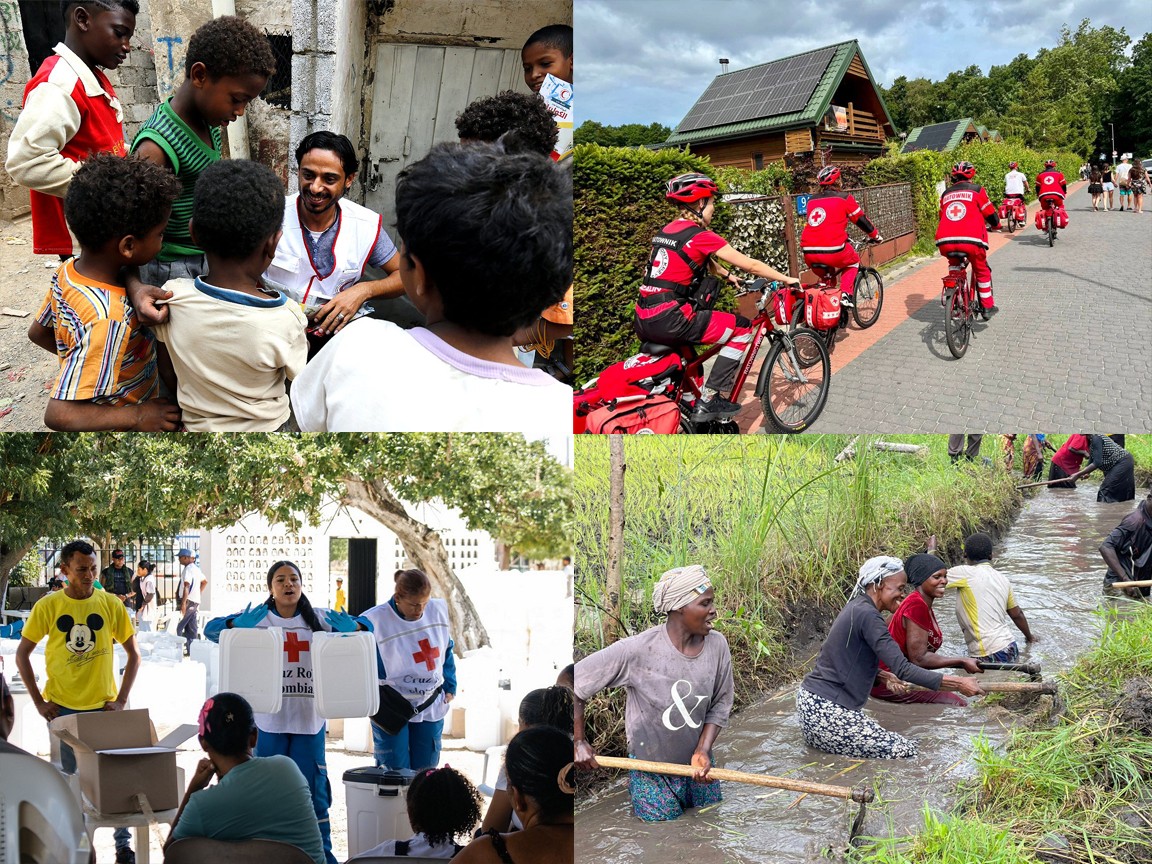
Red Cross Red Crescent climate action (from top left): cholera prevention, Yemen; heatwave beach patrols, Poland; safe water, Colombia; maintaining drainage, Uganda. (Photos from National Societies)