
#WorldMetDay: Red Cross Red Crescent announces major report on making early action for climate-related hazards future fit
By the Climate Centre
(The IFRC is global lead of the fourth pillar of the UN’s Early Warnings For All initiative, centred on preparedness for warnings – a key element of Anticipatory Action. The World Meteorological Organization, joint EW4All leaders, said on social media last week: “Earth observations provide the data we need to understand the risks of extreme weather events and make better decisions to protect lives, communities and economies. Only by observing today, can we protect tomorrow.”)
Climate change is changing. People all over the world, in both the global North and South, are familiar with the simple idea that climate impacts are intensifying: storms are getting stronger, especially in terms of the rainfall they inflict; hot summers that qualify as exceptional heatwaves are getting more frequent and droughts more punishing; seas are rising. To name but a few.
These impacts are not all growing at the same rate everywhere, however. New hazards not encompassed by existing plans for humanitarian Anticipatory Action are emerging, like glacial lake outbursts or dust storms; socioeconomic vulnerability is increasing in many places (or decreasing in a few) – the sort that leads people to settle on assumedly dried-up riverbeds or unstable hillsides, for example, that can become the locus of lethal flash floods or landslides in a matter of minutes.
Meanwhile, in many places, and especially in Sub-Saharan Africa and the Middle East, climate is combining with conflict and the human displacement that often goes with it to generate contexts – “cascading” impacts – that are difficult to forecast now and only likely to get more so.
This is the complex global reality being addressed for the first time in a major forthcoming report from the Red Cross Red Crescent being announced today on World Meteorological Day 2026. It’s supported by the UK Foreign Commonwealth and Development Office and the British and Swedish Red Cross, and is written by the Climate Centre in partnership with the IFRC, the BRC and the University of Reading.
The usefulness of the past as a guide
to the future is gradually being eroded
Anticipatory Action in the Red Cross Red Crescent mainly takes the form of Early Action Protocols: a stipulated amount of financial support for humanitarian interventions that is triggered when established forecast or meteorological thresholds (river levels, for example) are crossed. EAPs cover a wide range of hazards, including, in Chile for the first time anywhere in the world last month, wildfires.
These plans of action, largely of necessity, have so far been based on historical data; yet in a warming world characterized by “topsy-turvy weather” and a growing number of events described by the media, at least, as “unprecedented”, the usefulness of the past as a guide to the future is gradually being eroded.
Future Fit Anticipatory Action: Flagship Report 2026 – due to be published later in the northern spring – will be the first in-depth attempt in the humanitarian sector to grapple with this reality as it’s likely to affect the operationalization of Anticipatory Action.
Research for the report has been overseen by a Climate Centre team, including its science lead, Professor Liz Stephens of Reading University and its Senior Scientific Adviser, Dr Erin Coughlan de Perez, whose work on forecast-based financing more than a decade ago heralded the then-new concept of early action ahead of a hazard actually striking.
Production of the report was coordinated by Climate Centre Head of Anticipatory Action, Kampala-based Irene Amuron, and the lead writer was Adele Young – a PhD fellow in the Netherlands at IHE Delft and an expert on flood resilience.
A dramatic example of an evolving and increasingly lethal hazard to which the anticipatory community are turning their attention, with some success, is the phenomenon of rapidly intensifying storms such as Hurricane Melissa, which crashed through the Caribbean last October, bringing record-breaking wind and torrential rain to Jamaica as the island’s first-ever Category 5 landfall.
Although research has not yet established a definitive link with human-induced climate change, recent studies do suggest that since the early 1980s warmer seas and a more moist atmosphere mean the conditions that generate such storms are becoming more common.
“That makes it crucial for scientists to improve hurricane monitoring and forecast models, as well as for emergency responders to prepare for the scenario of an intense hurricane arriving with little time to prepare,” said Professor Stephens last year.
The Flagship Report 2026 will call for the humanitarian community to both keep pace with and utilize the latest developments in climate science – for training, including simulated disasters, and the actual design of plans for Anticipatory Action that will need to be relatively more flexible than currently.
Anticipatory Action may fall into irrelevance
if it doesn’t ‘stay current’
And cutting-edge science, of course, including the testing of hitherto unforeseen scenarios in workshop settings, becomes still more effective when combined with local, traditional knowledge, producing the best available picture of the future.
In charting sensible adaptation, the flagship report will also review some 30 existing national EAPs – both those that have been enacted, or triggered, and those that haven’t – and will seek to go some way toward plugging the gap that most existing evaluations leave behind: the question of how hazards will evolve or arise in the future. It will point to the danger of Anticipatory Action falling into irrelevance if it does not – as a doctor, engineer or airline pilot might say – “stay current”.
IFRC Secretary Jagan Chapagain wrote last year that Anticipatory Action remained a top priority for the Red Cross Red Crescent and closes the gap between “we knew” and “we acted”, sharing what he called the simple truth that “most of the deadliest disasters were forecast, yet people still suffered”.
The Flagship Report is intended to expand what “we knew” by shifting part of the gaze from the rear-view mirror to the road ahead, and with that the scope for effective interventions.
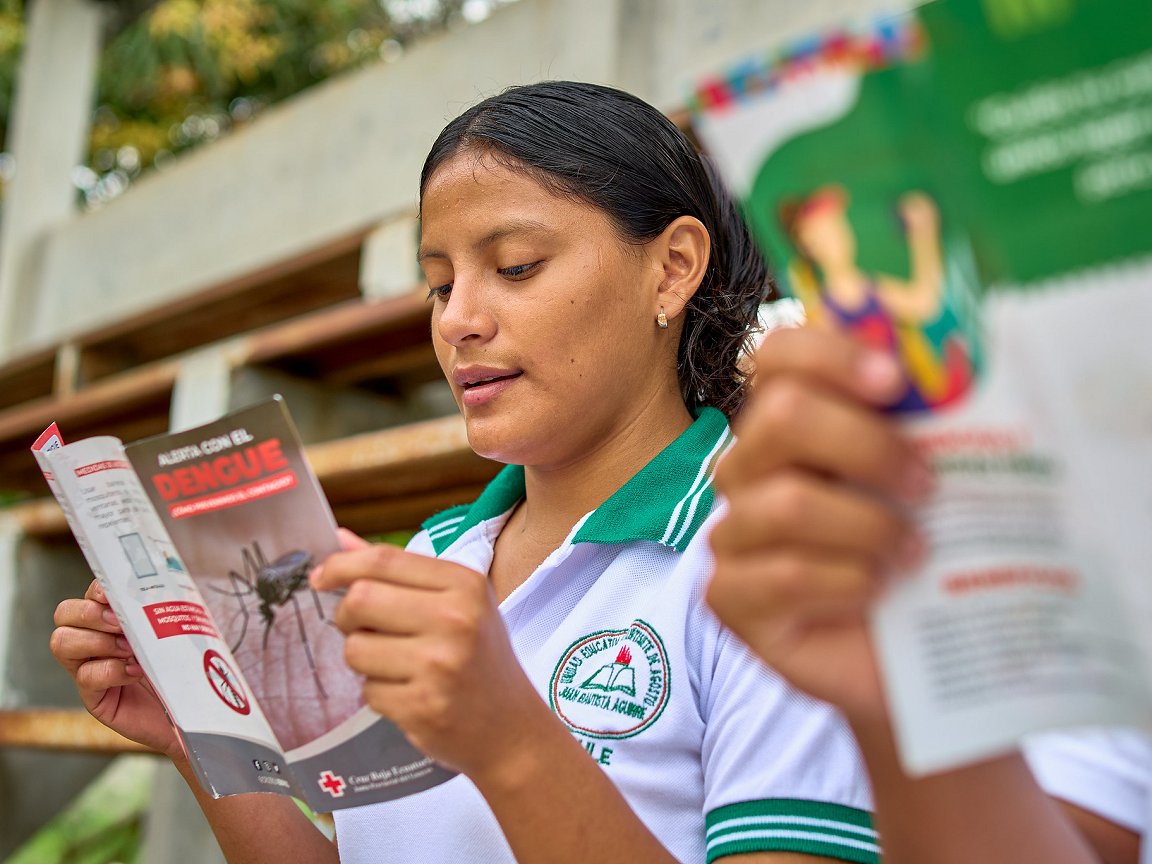
Ecuador Red Cross dengue prevention and awareness work in Santa Elena and Guayas provinces last year. As the wet, warm environments favourable to mosquitoes expand, so do the diseases they transmit to people, like dengue and malaria, and early action to meet the threat will need to adapt. As well as using historical data, the ERC is modelling potential future areas for an Early Action Protocol for dengue, its first. It’s one of the case studies in a forthcoming report on the future of Anticipatory Action worldwide. (Photo: ERC via Climate Centre.)