
The risks we face are beyond what history tells us: Adapting anticipatory action for the future climate
By the Climate Centre
The risks communities face are changing dramatically with the interaction of climate change with inequality, economic fragility, political instability and conflict, while the past offers scant guidance: to remain effective, humanitarian anticipatory action – first developed by the Red Cross Red Crescent Climate Centre and rolled out in Uganda more than ten years ago – must encompass new ways of assessing risk, updated triggers for action, and flexible finance.
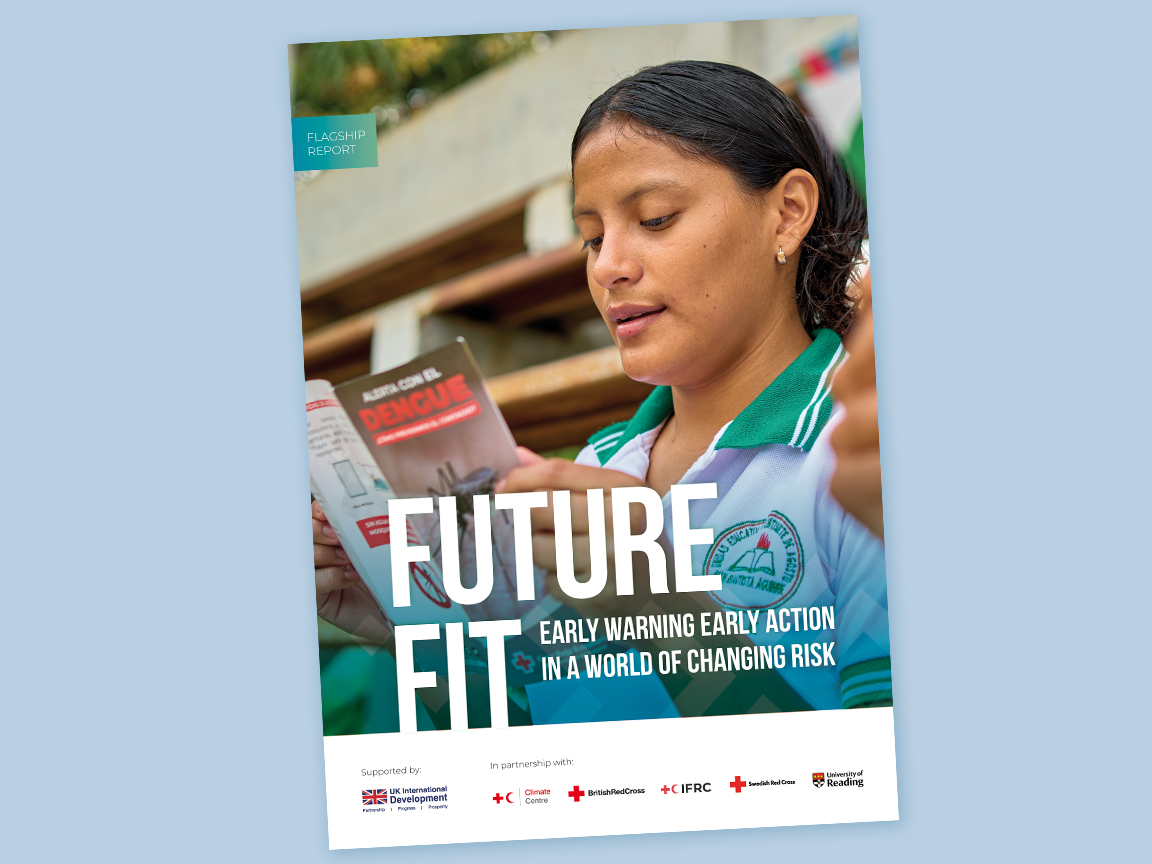
This is the chief conclusion of a flagship Climate Centre report, supported by the UK and Sweden and launched today. Anticipatory action needs to be adopted by governments and integrated with existing social protection, climate adaptation and risk management, according to Future fit: Early Warning Early Action in a world of changing risk.
“The risks we face have moved well beyond what history can tell us,” says a brief for policy-makers published alongside the main report.
The world is moving towards a sustained breach of the key 1.5°C threshold, it adds, and every fraction of a degree above that “will result in a future where the impacts of climate change will be realized with increasing frequency and intensity.”
Climate Centre Director Aditya Bahadur said that to deliver on a greater scale, anticipatory action requires “flexible financing, stronger coordination across sectors and borders, and closer alignment between scientific evidence and community realities.
“Ultimately, this is not just about improving how we respond to crises. It’s about transforming how we manage risk. By investing in early warning and acting on it decisively, we can move from reacting to disasters to preventing them, strengthening resilience, and safeguarding development in an increasingly uncertain world.”
‘An actionable, practical agenda’
Describing the messages in the report as “extraordinarily important”, the UK Foreign, Commonwealth & Development Office’s Gerard Howe said: “What we are all seeking to do is draw a ‘line of sight’ between what we do in our daily lives as a result of this report through to an end result of supporting people to lead safer, more dignified lives.”
The flagship report was researched, written and reviewed by a team of 20 Climate Centre experts, supervised by its Senior Technical Adviser Liz Stephens, a professor of meteorology at the University of Reading who leads international teams on forecasting and decision-making centred on humanitarian anticipatory action.
Professor Stephens said today: “Whether undertaken by communities, governments or humanitarian organizations, anticipatory action is key to turning an early warning system into lives and livelihoods saved. However, anticipatory action will need to evolve to stay relevant and effective for the extreme events of tomorrow.
“This is what future fit anticipatory action will look like, and in our report we draw on best practice to provide an actionable, practical agenda for evolving existing anticipatory action systems, helping us to imagine and prepare for the extreme events of tomorrow.”
The report charts five solution areas, starting with making risk assessment future fit and adapted to the changing frequency and intensity of hazards.
Triggers for early action should be designed from improved surveillance and monitoring, and accommodate unexpected events of increasing magnitude “outside the usual seasons and locations”.
Thirdly, the report advocates that agencies should “stress-test early actions to assess their effectiveness under different hazard scenarios” with locally led approaches guiding risk management.
It emphasizes the usefulness of simulations designed for future trends by climate and social scientists, and, finally, what it calls fuel funding – supporting action in the field on a relatively short timeline – should accommodate “rapidly changing population vulnerability and exposure [and] bridge short and long timescales”.
‘Systems need to change’
Stressing the importance of locally led adaptation, IFRC climate lead Ninni Ikkala Nyman noted that while the report says “we can’t do adaptation without early warning, the reverse is also true.”
Referring to the overall funding picture, she added: “We have a change in the current landscape and we still sometimes see more investment in response. But we need to see anticipatory action is there, that resilience is there. The systems need to change.
The IFRC’s Disaster Response Emergency Fund, of course, covers both anticipatory action and response, enabling communities to get automatic, accessible, flexible financing – all of which is crucial to meeting the future fit challenge, she explained.
Also acknowledging what she called a “very changed context” for funding, British Red Cross Head of Climate Resilience Erica Mason said: “The Red Cross Red Crescent Movement exists because people around the world believe, fundamentally, that when a crisis hits it shouldn’t hit as hard – that’s the bottom line.
“We think that communities and people and governments who want to support each other through crises have the ability to lead them and resource them.
“We just need to move the needle on finance from the ‘after’ to the ‘before’, ensuring communities are able to better able prepare after it moves.”
The report also includes six case studies drawn largely from IFRC and Red Cross Red Crescent National Society field experience: glacial lake outbursts, dengue fever in Ecuador, forecast triggers for floods in South Sudan, heatwaves in Nepal, various simulations conducted by the UN Food and Agriculture Organization (an implementing agency for anticipatory action), and flood insurance in Malawi.
“[A]s unprecedented flood after cyclone after drought has hit the headlines and been attributed to climate change, we have pondered how anticipatory action can play a better role in the effort to improve the outcomes of vulnerable communities,” the Climate Centre team say in their conclusion.
While recognizing that their recommendations are, “in many ways, aspirational, particularly as the funding landscape [is under pressure, the hope is] they go some way to reshaping how climate adaptation and anticipatory action work alongside each other over the decades to come.”
The flagship report on the future of anticipatory action was launched today alongside a shorter policy brief. The cover of the report shows Ecuador Red Cross work on dengue fever in Santa Elena and Guayas in 2025 – among case studies it details. (Image: Climate Centre/ERC)