
Climate Centre news review of 2025
By the Climate Centre
(A look back at the year’s main events and our engagement with them through the eyes of the Climate Centre news service.)
January
The IFRC Global Plan 2025, launched in mid-December and our first news story of 2025, set out the scale of the humanitarian challenges facing the world and outlines its support for National Societies in addressing them. “An era of polycrisis – overlapping, simultaneous and interrelated crises – is shifting to an era of permacrisis,” said Secretary General and CEO Jagan Chapagain.
The IFRC said that with the Climate Centre it would continue to support National Society assessments of climate risk in at least 15 more countries, and ecosystem assessments in three; new guidance developed in 2024 by the IFRC, ICRC, German Red Cross, and the Climate Centre on disaster risk reduction amid conflict was being operationalized in 2025; and the Climate Centre and the Livelihoods Reference Centre were to work together on climate-smart livelihoods in various countries, including Madagascar.
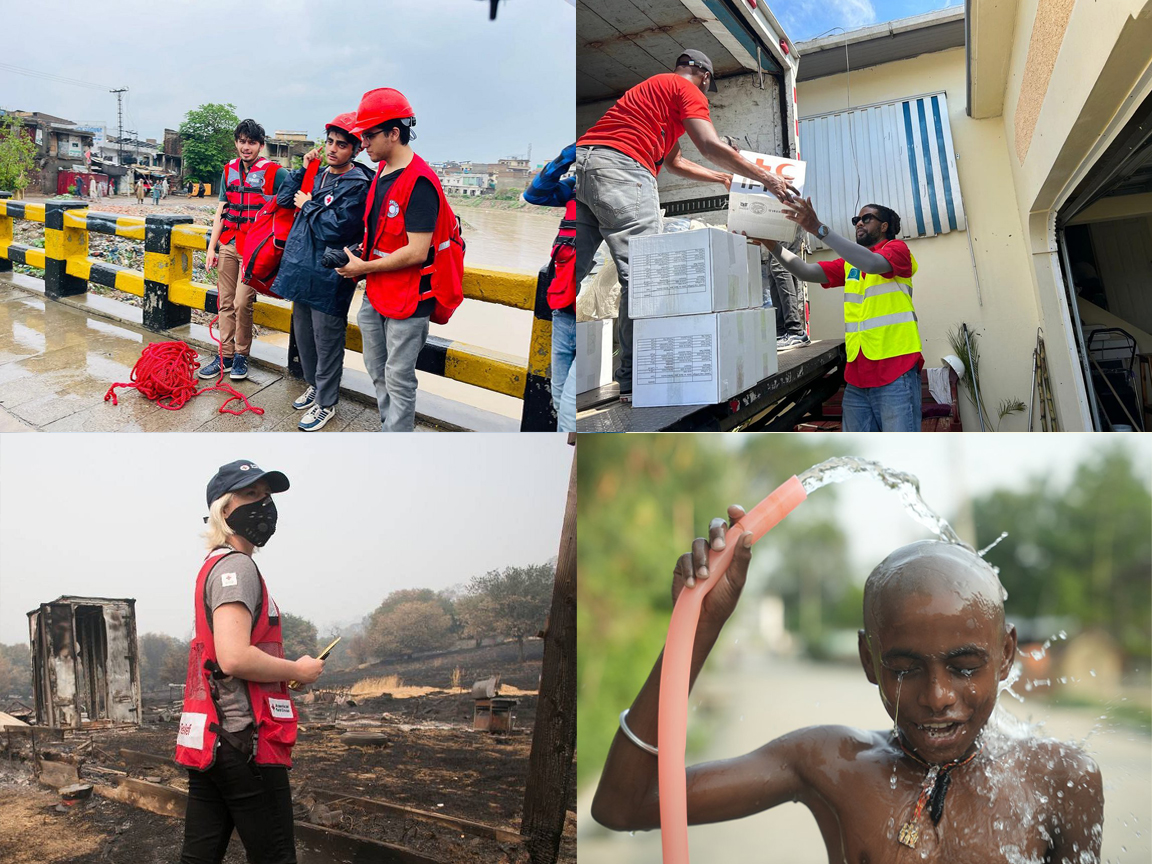
In one of the most widely read news stories of the year (judged by Google Analytics) the Climate Centre unpacked the science behind the devastating wildfires in California (pictured) and the fire weather that aggravated them, while a little later in the month, World Weather Attribution scientists found they had been worsened by reduced rainfall, dried out vegetation, and increasing the overlap between seasonal drought and strong Santa Ana winds.
Together with the ICRC, IFRC and the German Red Cross, the Climate Centre jointly published A handbook for navigating fragility, conflict and violence, centred on communities beset by fragility, conflict and violence that are also disproportionately affected by disasters.
We updated a 2019 brief on how the timely use of weather and climate information by the Red Cross Red Crescent and other humanitarian agencies helps national met services see how their work guides decision-making.
February
The Somali Red Crescent activated the early action protocol for drought that was published by the IFRC the previous August, implementing early actions for some 30,000 people at risk in the Togdheer, Sool, Bari and Mudug regions. Together with the Heidelberg Institute for Geoinformation Technology and the German Red Cross, we provided technical support centred on assessment, triggers, forecasting and information management.
Government entities in Europe were invited to take part in a voluntary survey ahead of the second call for grants of up to 210,000 euros under the Pathways2Resilience programme that National Societies can join in consortia with their local authorities and with which the Climate Centre is a key humanitarian partner.
March
With January confirmed as the 18th in the previous 19 months when the global average temperature was more than 1.5°C above the pre-industrial level, Climate Centre Director Aditya Bahadur said in an interview with the Finnish Red Cross that “[w]e have entered uncharted territory. The natural and weather systems of the Earth are now changing rapidly in ways we do not fully understand.”
The objective of the Climate Centre was to bring together science, policy and practice for the Red Cross Red Crescent Movement and stakeholders, and he listed the most urgent actions to slow down the rate of climate change and mitigate its consequences.
With colleagues from Zurich Climate Resilience Alliance, an IFRC partner organization, Climate Centre Head of Urban and Attribution Roop Singh, wrote in a blog that compound events in which two or more hazards such as heatwaves and floods occur simultaneously or in close succession are becoming more common.
As climate change intensified the frequency and severity of extreme-weather events, the phenomenon was becoming increasingly critical to understand and address, while urbanization exacerbated risks through the urban heat-island effect.
Together with the Anticipation Hub, the Climate Centre joined several external partners in jointly publishing a Toolkit for anticipatory action in fragile, conflict- and violence-affected settings.
‘The natural systems of the Earth are changing rapidly in ways we do not fully understand’
April
WWA scientists found that an extraordinary spring heatwave in Central Asia, driven by climate change and 4°C hotter than the pre-industrial average, included the second-largest increase of nearly 30 such events they had studied.
And in a separate finding they called for greater investment in climate science and weather stations in Africa to help countries understand changing extremes and prepare for the future: of a total of seven WWA studies that had produced inconclusive results, four were of weather events in Africa.
On Earth Day 2025, Jagan Chapagain said there is “no greater threat facing humanity than the climate and environmental crises” and no greater priority for the International Federation. For his part, Aditya Bahadur said: “Red Cross Red Crescent societies around the world are on the front lines of the fight to reduce climate risk. We at the Climate Centre are privileged to be able to support them with the know-how to achieve meaningful climate action.”
May
In a blog from Bangkok, the Climate Centre’s Florence Pichon introduced a new report compiled jointly with the UN Food and Agriculture Organization examining the potential of a special financing mechanism for anticipatory action in Timor-Leste – one that can reach remote corners of the country where the most vulnerable people live.
From Paris, our Karine Zoghby reported on a Dubai meeting of 24 professionals from across the Middle East and North Africa training on impact-based forecasting for MENA – the first session of its kind in the region. The workshop was jointly organized by the IFRC, several National Societies, and the Climate Centre as part of the UK-supported Istibak project, in collaboration with the UK Met Office and its WISER programme.
And in a busy month for Climate Centre bloggers, Fleur Monasso – on a visit to Portugal – wrote about a major climate event organized by the Braga branch of the Portuguese Red Cross for World Red Cross Red Crescent Day on 8 May.
We republished a transcript of a conversation, the first of a two-part series, between Harm Goossens, Netherlands Red Cross Director and Climate Centre board member, and Mark Schraauwen, CEO of Rotterdam-based Verstegen Spices & Sauces BV – a company feeling the impacts of climate change on its global operations, the first of a pair. It appeared initially in Dutch in Het Financieele Dagblad.
June
The IFRC took the occasion of the 2 June Heat Action Day to release a flagship report produced jointly with the Climate Centre to highlight how rising global temperatures are making heatwaves more frequent and intense, pointing out that as many as 4 billion people experienced at least an additional month’s worth of extreme heat due to climate change in the year to date.
Coinciding with the day, the Climate Centre announced publication with the Nepal Red Cross of a comprehensive heat action plan for the western Nepalese city of Dhangadhi that suffers relentless yearly heatwaves of more than 40°C because of its low elevation aggravated by rapid urbanization and lack of green spaces (file picture).
Harm Goossens’s second private-sector interview was with Meine van der Graaf, impact manager at Wakuli – a Dutch sustainable coffee brand that pays 16,000 coffee farmers in 13 countries a fair price and helps them work sustainably.
WWA scientists studying the extreme rainfall that hit eastern Australia in May found no clear trend between increases and decreases in heavy rainfall and advocated “low-regrets adaptation measures that are beneficial in both wet and dry environments”.
At a busy Global Platform for Disaster Risk Reduction in Geneva, where Jagan Chapagain renewed his call for the urgent matching of investment in early warning with capacity, Climate Centre technical adviser Tesse de Boer outlined opportunities for scaling up multi-risk anticipatory action; and Catalina Jaime, as lead on climate and conflict, moderated a session on multi-hazard early warning systems in fragile, conflict- and violence-affected settings.
Aditya Bahadur, who followed the event online, said “GPDRR represented a welcome shift toward under-addressed but critical areas: multi-hazard early warning, heat risk, locally led action, and risk reduction in FCV settings.” He was “glad to see the IFRC-Climate Centre innovation booth became a real hotspot – organized and managed by our anticipatory action lead, Irene Amuron, and Fleur Monasso, our Europe lead – proving again that a little bit of creativity goes a long way in sparking meaningful dialogue on the future of DRR and adaptation.”
Climate change made the record-breaking May heat in Iceland and Greenland 3°C hotter, WWA scientists said, adding that early and unfamiliar spring heat threatened people in Iceland with health issues as did thinning sea-ice for the livelihoods of communities in Greenland.
The Climate Centre published new research shedding light on the exposure to climate hazards of forcibly displaced people worldwide, grouping climate science, GIS methodology, and a new dataset on the locations of over 60 million forcibly displaced people.
‘Low-regrets adaptation measures that are beneficial in both wet and dry environments’
July
Phone-camera videos taken by Texas residents graphically illustrated the terrifying speed and ferocity of the flash flooding on the River Guadelupe that claimed scores of lives, many of them children at a summer camp.
Climate Centre science lead Liz Stephens commented: “Again and again globally, with climate change fuelling more intense rainfall, we have seen how our early warning systems – even good ones – are just not designed for what’s possible even now, let alone what’s coming in the future.”
After the World Meteorological Organization reported that sand and dust storms are exacting an increasing toll on human health and economies, Burkina Faso-based Climate Centre scientist Kiswendsida Guigma said that as well as aggravating respiratory and cardiovascular conditions, there is strong evidence in parts of the Sahel linking exposure to dust with meningitis.
The Red Crescent Society of Kyrgyzstan completed a series of early actions for heatwave in the south of the country begun when it activated an early action protocol first developed with Climate Centre input after severe heat as high as 40°C was forecast in three regions.
August
In a blog, the Climate Centre’s Senior Technical Adviser on Health, Tilly Alcayna, introduced her jointly authored examination of how infectious diseases are affected by climate factors, highlighting three key characteristics of such diseases: seasonality, geographical distribution, and year-to-year variation linked to climate phenomena.
WWA scientists concluded climate change intensified by as much as 15 per cent monsoon rain in Pakistan (pictured) that the authorities said had killed hundreds of people. In a second August study, they said Norway, Sweden and Finland, all of which lie partly above the Arctic Circle, had experienced at least two weeks of unusually hot weather with temperatures above 30°C – a heatwave made 2°C hotter and at least ten times more likely by climate change.
The IPCC announced it had appointed 664 experts from more than 100 countries for its seventh assessment of the global climate – known as AR7 – as authors and editors. They include four Climate Centre experts: Board Chair Debra Roberts, who is a Coordinating Lead Author for the IPCC Special Report on Climate Change and Cities; Julie Arrighi, Director of Programmes, who will contribute Working Group I; Roop Singh, also a Lead Author, contributing to Working Group II; and Catalina Jaime, a WGII Lead Author on poverty, livelihoods, mobility and fragility.
(And Bart van den Hurk, Scientific Director at Deltares and IPCC Working Group II Co-Chair, congratulated Catalina on her PhD completed under the auspices of the Netherlands Princess Margriet research chair.)
In the wake of Hurricane Erin, which tore through Cape Verde and triggered an IFRC emergency appeal for 3 million Swiss francs, the Climate Centre’s Andrew Kruczkiewicz – a lecturer at Columbia University specializing in remote sensing and early warning – said there is a need for improving forecasts of both rapid intensification and its impacts, but if done collaboratively with national met services new data could strengthen modelling for wind, precipitation, and storm surge.
September
Our Sayanti Sengupta joined Jana Bischler of the ILO and the FAO’s Matthew Walsham, as co-chairs of the USP2030 Working Group on Social Protection and Climate Change to write a blog welcoming the link drawn between climate action and social development for the world summit for social development in Qatar.
Climate change made the hot, dry, windy conditions that fuelled the wildfires that reportedly left 1 per cent of the entire Iberian peninsula charred and burnt some 40 times more likely and 30 per cent more intense, a rapid WWA study found.
The 2025 youth climate summit, the fifth in the annual series, acknowledged how the role of youth has become even more critical in catalysing solutions and ideas in their local communities. It was organized by the Climate Centre and the American Red Cross, supported by the IFRC secretariat in partnership with the Global Youth Mobilization network.
The ICRC special appeal for 2025 aimed to enhance the resilience of millions of people affected by the compounding impacts of conflict and climate risks. The ICRC operates in all but four of the 50 countries considered most vulnerable to climate change but least prepared to adapt; with National Societies and the Climate Centre, the ICRC said it was deploying a “conflict-sensitive, climate-informed approach to deliver principled assistance to, and strengthen resilience for, hard-to-access populations”.
In a blog from Antananarivo, our Dorothy Heinrich and Liz Stephens advocated factoring scenario planning into the design of anticipatory action, already used in the humanitarian sector in desktop exercises and simulations to sharpen decision-making.
Catalina Jaime gave an interview to Colombia’s El Espectador newspaper, in which she said her contribution to AR7 would centre on global evidence on adaptation amid fragility and poverty, and where livelihoods are precarious or there is displacement.
‘Even good early warning systems are just not designed for what’s possible now,
let alone what’s coming’
October
A new report by the Climate Centre looked at how climate services for health – including early warning, risk maps, seasonal calendars, and climate projections related to health issues – are currently factored into decision-making in healthcare systems, and how that relationship might be deepened. It includes a review of evidence globally and case studies of Bangladesh, Colombia, Malawi and Senegal and was one of our most widely read publications on the year.
In the run-up to COP 30, Climate Central and WWA experts warned that even the 2.6°C global temperature increase implied by current national commitments, if observed, would still subject future generations to dangerous heat and severe health impacts. They called stronger commitments to the 2015 Paris Agreement and policies to accelerate the transition away from fossil fuels and keep warming well below 2°C.
In a blog, Fleur Monasso and Sayanti Sengupta wrote about a stocktake by nearly 40 European cities and regions involved in the Pathways2Resilience programme that found “measurable shifts in awareness and institutional approaches to climate adaptation”.
The IFRC released its key messages to the forthcoming UN climate talks in Brazil, leading with a call to the international community “to hit climate change head-on”, adding that it was focusing on three areas: health and well-being, investment in people and communities, and the timing required to enable humanitarians to get ahead of disasters.
The opening online segment of the year’s two-part Development and Climate Days was intended to “create a set of key messages [for] COP 30 to help influence climate decisions, recognizing the most vulnerable people and groups at the front lines of climate change.”
In a piece for the Conversation, Liz Stephens and her Reading University colleague Alexander Baker explained how the phenomenon of the rapid intensification of storms is becoming more common with global warming; in a single day, Hurricane Melissa (pictured) had exploded from a moderate storm into a major hurricane with 170mph winds.
November
WWA scientists said climate change significantly increased wind speeds and rainfall from Hurricane Melissa, as well as the likelihood of the atmospheric and oceanic conditions leading to powerful storms, but in a separate study issued in November of the deadly rainfall that hit Mexico’s Gulf Coast the previous month they said current models and observations had not represented it consistently enough to come to a firm conclusion.
ESRI’s Olivier Cottray interviewed the Climate Centre’s Cornelia Scholz about her work with the ICRC Mali delegation to develop a borehole stress index that fuses satellite data with local information about conflict, vulnerabilities, and water access, enabling water engineers to base decisions on where to drill on combined environmental and security risk instead of even educated guesswork.
Arguing that only through locally led adaptation to climate change will vulnerable people feel the benefits soon enough, the IFRC published a brief jointly authored with the Climate Centre and launched at a COP 30 side-event we moderated.
Speaking to the COP 30 audience, Jagan Chapagain and Aditya Bahadur both stressed the importance of adaptation in the absence – this year at least – of progress on mitigation. The IFRC Secretary General called for a “giant leap forward on adaptation” while the Climate Centre Director described D&C Days as the event “for all those who are passionate about placing adaptation at centre stage in global climate policy discourses”.
December
Beginning in late November after cyclones struck Sri Lanka and South-East Asia almost simultaneously, the monsoon inflicted catastrophic damage on multiple nations and total deaths that ran into four figures. In early December, WWA released a rapid study of Cyclones Ditwah and Senyar, reporting that associated extreme rainfall is being “supercharged” in the region, with observations showing a substantial increasing trend in heavy rain over recent decades.
Our Reading University colleague Akshay Deoras also commented that climate change “is rewriting the Asian monsoon. Rain now arrives in sharper bursts, dry spells stretch further, and downpours hit with greater ferocity. What was once a steady heartbeat for communities has become an erratic pulse, capable of unleashing a month’s rainfall in just one day.”
IFRC-DREF’s annual report described the Climate Centre “a pivotal member of the [anticipatory action] validation committee, contributing to the review of epidemics protocols, the level of expectations concerning the trigger statements in the protocols, and the conditions under which a [National Society] should or should not seek trigger alignment with other actors.”
A few days after the WMO reported that temperatures in the MENA region are rising at twice the global average, we issued detailed guidance on operating anticipatory action for displaced people and refugees centred on the Middle East and North Africa.
We also published a comprehensive introduction to our work to assist the ICRC in integrating climate risk into their operations: multiple delegations and global teams were engaged and supported through applied research and strengthening of capacity, while 12 delegations were provided with operational support through our helpdesk
The tenth anniversary Global Dialogue Platform in Berlin was opened by the Climate Centre’s Kampala-based Head of Anticipatory Action, Irene Amuron, who said that “seeing governments such as Bangladesh and the Philippines, among others, institutionalize anticipatory action within their disaster-risk-management frameworks is something to celebrate.”
Clockwise from top left: Pakistan Red Crescent volunteers pause for breath while assisting people affected by the latest monsoon floods, one of the most lethal events of the year, which killed more than 1,000 people over three months in that one country alone, according to the UN; Jamaican Red Cross relief for Hurricane Melissa, the only Category 5 storm to have made landfall in Jamaica in modern times; a young Nepalese boy cools off in heat that again this year forced schools and workplaces to close in the country’s lowland areas (file pic); American Red Cross volunteer Jillian Robertson surveys a property in Vacaville, California destroyed in the January wildfires. (Photos: National Societies via IFRC/American Red Cross)